
One of the biggest strategic decisions authors face is whether to write standalone books or build a series of books. This choice doesn’t just shape your storytelling—it impacts your marketing, reader retention, and long-term revenue potential.
The truth? There is no single “right” approach. But understanding how each strategy works and how it aligns with your genre and goals can help you build a stronger, more sustainable author business.
What Is a Standalone Book?
A standalone book is a complete story told in a single volume. It has a clear beginning, middle, and end, with no required follow-up reading to reach a conclusion to the conflicts that arose in the book. It also has self-contained character arcs and does not depend on previous books for clarity, though it can still exist alongside other unrelated works.
Common genres that more frequently utilize standalone books include:
- Literary fiction
- Contemporary fiction
- Romance (some subgenres are also commonly written as series)
- Thriller and mystery (sometimes with recurring characters)
- Horror (sometimes with interconnected lore or with recurring characters)
- Children’s books (also sometimes with recurring characters)
- Nonfiction
This list of course is not exhaustive, and there are many authors who write standalones in many other genres.
What Is a Book Series?
A book series is a collection of books connected by story, characters, or world. Each installment builds on the previous one, or at least benefits from being read in order.
There are a few different types of series that are most often utilized:
- Sequential series: One continuous storyline between books
- Episodic series: Self-contained plots with recurring characters
- Interconnected standalones: Independent stories set in the same world
But the most common genres that tend to utilize series are:
- Fantasy
- Romance (also included here, as some subgenres utilize series)
- Science-fiction
- Mystery and crime (often self-contained plots with recurring characters)
- Young adult and middle grade
Once again, this list of genres is not exhaustive, and there are many authors writing full series of books in additional genres.
Pros and Cons of Writing Standalone Books
The most common pros of writing standalone books include:
- Easier entry for new readers: Readers can jump in without any prior knowledge, making discovery simpler
- Creative freedom: You can explore new ideas, genres, and characters with every book
- Lower long-term commitment: There’s no pressure to continue a storyline if your interests or your audience’s interests shift
- Broader appeal: Standalone stories can often attract casual readers who prefer low commitment as well as readers who enjoy series
And some of the most common cons of writing standalone books include:
- Harder to build read-through: Each book must be able to sell itself, because there’s no automatic continuation to the next in series
- More marketing effort per book: You’re essentially starting from scratch with every release
- Less momentum over time: Series naturally compound visibility and sales, whereas standalones don’t do so as easily
Pros and Cons of Writing a Series
The most common pros of writing a series of books include:
- Strong read-through potential: If readers enjoy book 1, they’re more likely to buy books 2, 3 and beyond
- Easier long-term marketing: Promoting one book can lift the entire series, keeping sales of all books in that series consistent
- Deeper reader investment: Fans become attached to characters and worlds over time, keeping them coming back and engaging more
- Stronger branding opportunities: A cohesive series can help more clearly define your author identity
And some of the most common cons of writing in a series include:
- Risk of drop-off: Your readers have to stay committed to the series, and if they don’t continue past book 1, the rest of the series suffers
- Harder entry point: New readers can’t read your newest release in the series until they’ve gone through the previous books in the series
- Continuity challenges: Plot threads, timelines, and character arcs must remain consistent from book to book
- Slower creative pivoting: It’s harder to change direction mid-series without confusing readers or causing dissatisfaction
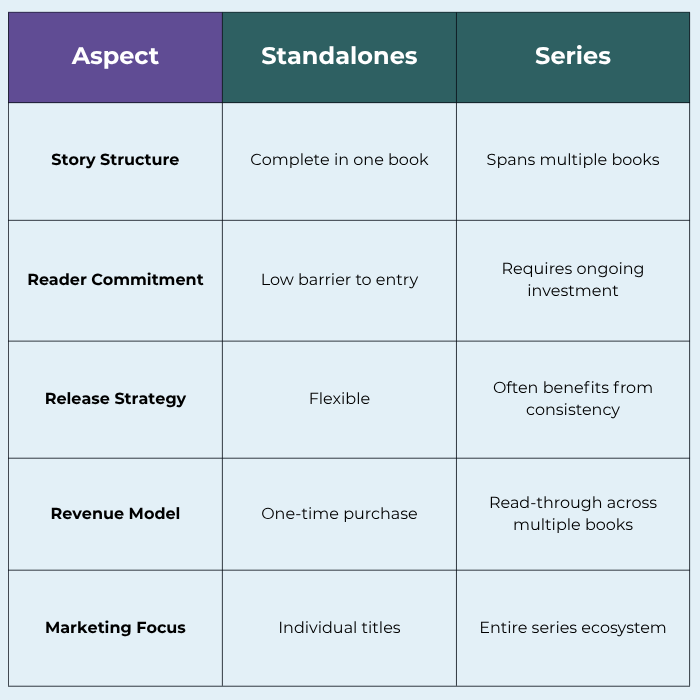
Key Differences Between Series and Standalones
How Genre Expectations Influence Strategy
While you can write either format in most genres, reader expectations play a huge role in success.
As mentioned, some of the most common genres that favor writing in series are:
Fantasy and Science-Fiction
- Readers expect immersive worlds and long arcs
- Series allow for deep lore and character development
- With more characters and backstory, there’s even more potential for connected spin-offs or related expansion
Mystery and Crime
- Popular in episodic formats with recurring detectives or other characters
- Readers enjoy familiar people solving new cases
- These characters sometimes have story threads that weave between books
Romance
- Many romance authors use interconnected standalones or family and friend-based stories to build series
- Readers love revisiting familiar settings and side characters from other books
- The romantasy and paranormal fantasy genres especially make use of long series
And some of the most common genres that tend to favor standalone books are:
Literary Fiction
- Focuses more on theme, prose, and individual narratives
- Often prioritizes character depth over plot continuation (though the plot always has a complete arc)
- Awards specifically in critical recognition tend to favor standalone works
Contemporary Fiction and Romance
- Often centers on unique, one-off stories
- Explores specific moments, relationships, or life transitions (making romance a popular genre for standalones as well)
- More flexibility to tackle diverse topics without having to worry about ongoing continuity
Thriller and Suspense
- Many are designed as single-case, high-impact reads (though exceptions exist)
- Relies on tightly controlled pacing and contained tension so that twists and reveals are built with a one-time payoff
- The standalone format helps preserve suspense without dilution across a sequential series
Hybrid Approaches
Just because you write in a specific genre or have a preferred attention span for the stories you write doesn’t mean you must strictly choose one approach or the other. Many authors have found great success implementing both strategies.
Some popular hybrid models of writing books include:
- Interconnected standalones: Each book stands on its own but shares a deeply related world or cast of characters
- Duologies or trilogies: Still a series, but shorter in length and with a more closely defined endpoint
- Series and standalone mix: Writing series for more income stability and standalones for creative exploration
Having some flexibility and exploring a hybrid model can help you meet reader expectations, while still exploring your own creativity. You do, however, want to be mindful of avoiding burnout in the process of trying to chase a large-scale hybrid model.
Which Strategy is Right for You?
Instead of trying to deduce which strategy is “better,” come to a more honest answer for yourself and your unique situation by asking:
- Do I enjoy writing long, continuous stories?
- How important is fast read-through income to me?
- Does my genre lean toward series or standalones?
- Do I want flexibility or consistency in my writing?
But when in doubt, there are generally two practical rules of thumb you can consider:
- If your genre tends to reward binge reading, then lean toward writing a series
- If your stories are more concept-driven than anything, lean toward writing standalones
But once again, there’s no “right” answer here—all kinds of authors have found varying degrees of success following these rules of thumb, but also by forging their own paths entirely. The key is finding alignment between your creative instincts, your genre expectations, and your long-term goals for your author business.
Related Questions
Is it better for new authors to start with a series or a standalone?
It depends on your genre. In genres like fantasy or science-fiction, starting with a series can help to build momentum and read-through. In other genres, like literary or contemporary fiction, it may be a better entry point to write a strong standalone that will attract your first readers.
Can a standalone book be turned into a series later?
Yes, this is entirely possible, and many authors expand successful standalones into series. They do so by continuing a central storyline or exploring side characters from the same story or world. Even if the first book came to a concrete resolution, it’s possible to invent new related conflicts for characters to face in subsequent books.
How long should a book series be?
There’s no fixed rule here. Some series are as short as two books (called duologies), while others span ten books or more (with no finite end in sight). The ideal length depends on your story, reader demand, and your ability and interest to maintain quality and consistency.
