Authors generally have an affinity for words, so considering a platform that exists on a diet of photos, videos, and graphic art is a big decision. If being an author is already your career, or if you’d like it to be, you’ll have to find some way of connecting with readers and convincing them to go out and buy your book.
A quick search on Instagram shows that #reader has over 11.1 million posts, #bookaholic has 11.7M, #bookish has 25.3M and #bookworm has 34.7 million posts.
Is Instagram for authors? I’d say readers are on the platform in full force, so that's a pretty strong sign pointing toward yes!
This is not a “how to set up Instagram” article. But if you’d like to get your name and book in front of those millions of readers, this article is dedicated to providing you with research-based information to help you find your crowd by exploring the various types of content you can share, best practices to using Instagram efficiently as an author, and mistakes that are painfully common that you might want to avoid.
Should Authors Use Instagram
Authors do use Instagram to find their readers and engage with their communities, so yes, “they” as a collective should use the platform. But a better question is whether you, as a unique, one-of-a-kind person and author should use Instagram and the answer to that is much more complicated.
You do not have to use Instagram. You can be a successful author without it. There are infinite possibilities to choose from when it comes to finding readers and promoting your books. But you may choose to use Instagram, and you may find great success with it, if it matches your personal preferences and author goals.
Let’s start with personal preferences.
- Do you personally browse on Instagram?
- Do you like the platform?
- Do you have the ability to take pictures and/or videos?
- Are you comfortable using Canva or other graphics editing programs to create images?
- Do you enjoy interacting with people who share your interests through comments and consuming their content?
If you were strongly against all of the above, you may want to try something else. If you answered yes, or yes-ish, to a majority of those questions, Instagram might be a good personal fit for you.
If you’re still not sure, consider whether or not it fits with your author goals at the moment.
Is Instagram Right for Your Author Goals?
As an author, you will have different goals at different points in your process. The ultimate goal is to sell your book, but to do that, you first have to write your book. Then you’ll need to edit it (probably many times over), format it, get a cover designed, and launch it. Then there’s the sales and marketing. Sprinkled throughout you’ll also need to build up a list of potential buyers, maybe build yourself a website and perhaps even a store to sell your books directly to your readers…
There are a lot of steps is what I’m saying.
If all the energy you have to devote to your writing career is completely and utterly focused on writing, then trying to learn Instagram might not be what you need to do right now.
But if you have the capacity to dedicate some amount of time each day or week to attracting and connecting with potential readers, maybe building up your Instagram can help.
Bookstagram vs Instagram for Authors
Some authors may build their Instagram accounts with “bookstagramming” as their focus, but being a Bookstagrammer should not be confused with using Instagram to support your author career.
Bookstagram is a niche corner of the platform that has risen to great popularity (along with BookTube and BookTok) by centering accounts around books and bookish culture. Bookstagrammers will typically share detailed book reviews alongside aesthetic home libraries and bookshelves to die for and/or cozy reading nooks.
They are not dedicated to a single author, though they are often centred around a specific genre as a way of curating a highly engaged community. Bookstagrammers who take their accounts seriously can sometimes make it into their career—the influencer side of the bookish community.
While you can be an author and a Bookstagrammer, they are two wholly separate jobs and it would be smart to know which is your focus.
If you are an author, first and foremost, you can still share reviews, bookish culture, and cozy reading aesthetic vibes, but rather than trying to become an influencer, think of yourself as more of a dedicated literary citizen. You’re not trying to get paid to promote, you are trying to find your perfect readers and generate goodwill with your fellow authors so you have people who will help you promote and celebrate your wins.
You may, however, want to develop relationships with Bookstagrammers in your genre niche as they can be powerful allies when it’s time to promote your next book launch!
For the purposes of this article, we’re going to focus less on Bookstagram and more on using Instagram to support your readership, author career, and goals.
Instagram Content for Authors
The first major question authors ask themselves when starting up an Instagram profile devoted to finding a perfect reader audience is, “what the heck am I supposed to post?”
As mentioned above, you could go the Bookstagrammer route, but I’d recommend being very aware of the audience you’re developing and be sure to stay transparent. If you post reviews and recommendations while you’re writing and then suddenly start promoting your book and nothing else, that’s not going to go over well.
A general rule of any audience-building goals is to talk about what you know. For authors, especially in the pre-published moment, that’s writing. We know a lot about writing and probably love to talk about it!
You know who also loves to talk about writing? Other authors.
To be very clear, authors are a great segment of any niche audience. Many of us write because we fell in love with reading, and continue to read voraciously. But targeting authors specifically as your readership should come with some disclaimers:
- Authors tend to be critical readers, because they spend so much time on craft and storytelling, they see any flaws, even if they’re not really flaws, but projections
- Authors make great cheerleaders for their fellow authors. We love to support our peers and celebrate each other's wins.
You have to take the good with the bad, in every situation.
Ideally, you’ll be targeting readers of your very specific niche, so the content you create should be for them, whether they’re fellow writers or not.
So what do you know about your book(s) in order to create content around?
- Characters: talk about your characters as if they’re real people. Add drama, humor, and we all know sex sells. If you’ve got it, flaunt it. Find inspiration in content types not just for books, but for the type of character you’ve written. Got a Karen? Watch some Karen’s getting instant Karma videos and make your own fictionalized version. Maybe your MC owns a coffee shop, veterinarian's office, or nail salon. Search for real life versions of those types of accounts and see what’s working for them.
- Setting: if it’s a real place, Instagram is a wonderful platform to share photos and travel adventures. If you haven’t been yourself, share with your audience why you loved this location enough to include it in your book and whatever fun facts make it into your story (without spoilers!). If it’s a made up place, you have unlimited opportunities to make it feel real to your potential readers. Commissioning art for maps, landscapes, etc is a great way to create a visceral need to experience more, but you can also use your words to paint an imaginary picture. You’re an author, we know you’ve got the talent!
- Genre: This one is easy to research. Just type in #yourgenre and see what posts are ranking up the views and read the comments sections. Talk about things that readers of your genre are obsessed with. Get controversial with some “hot takes.” You’ll find a lot of Bookstagrammers this way, so it’s a smart opportunity to leave some likes and comments and start those relationships building, but also learn the loves and icks that are firing up the Instasphere.
- Themes: if you’re anything like me, your personal Instagram feed is full of people talking about the themes you’re writing about. Join those conversations! Share your take. Even if you’re talking about the real world versions, you’ll be attracting real people who take part in those conversations and will be more likely to want to read about those themes. What is a theme, you ask? Addiction, the quest for immortality, sacrifice, honor, vanity, rebellion, doomsday! Shout out to @writers_helping_writers_angela and the amazing collection of Thesauruses (and other writing tools) available at One Stop for Writers.
- Dialogue: You know that moment, usually around half an hour after the perfect moment, when the comeback of all comebacks rises to the surface of your mind and it’s too late to deliver, but not too late to give to one of your characters? Share it. Share that and the sweetest moments between your love interests, the most hilarious Freudian slips, and anything witty enough to have your potential readers thinking to themselves, “I’ve gotta save that for later.” Because they might just save your post and that’s great for the algorithm!
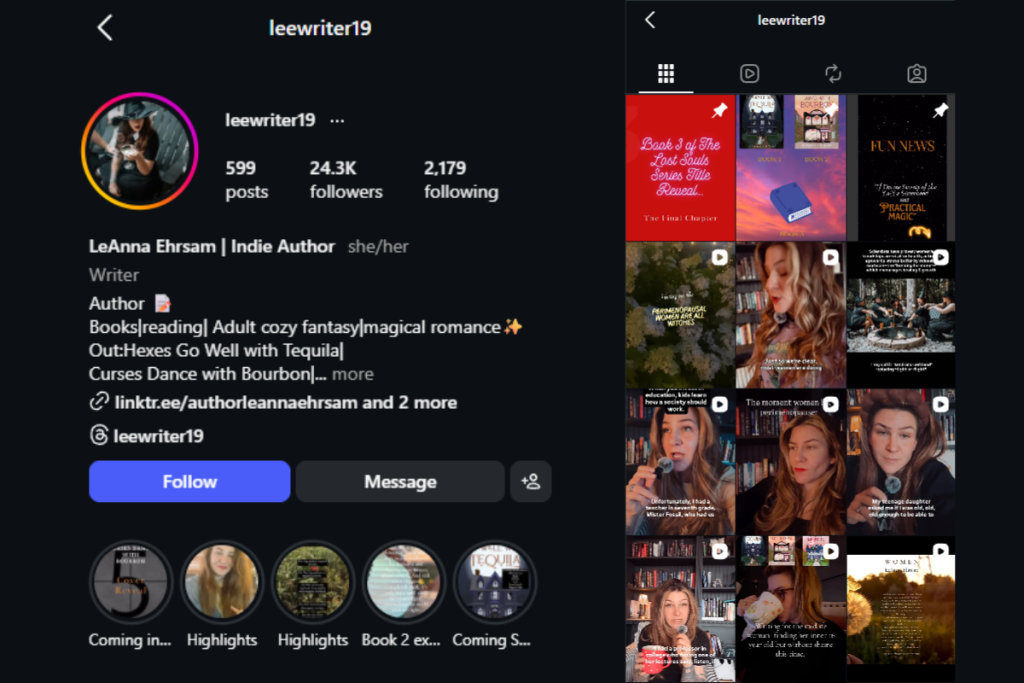
- Other: Cheeseburgers. This comes from @leewriter19: “I think we’re in a time of people needing authenticity. I know exactly who my audience is and what they will connect with. Find out what your audience craves. It’s kind of like feeding people. You aren’t going to feed someone whose favorite food is cheeseburgers a salad.”
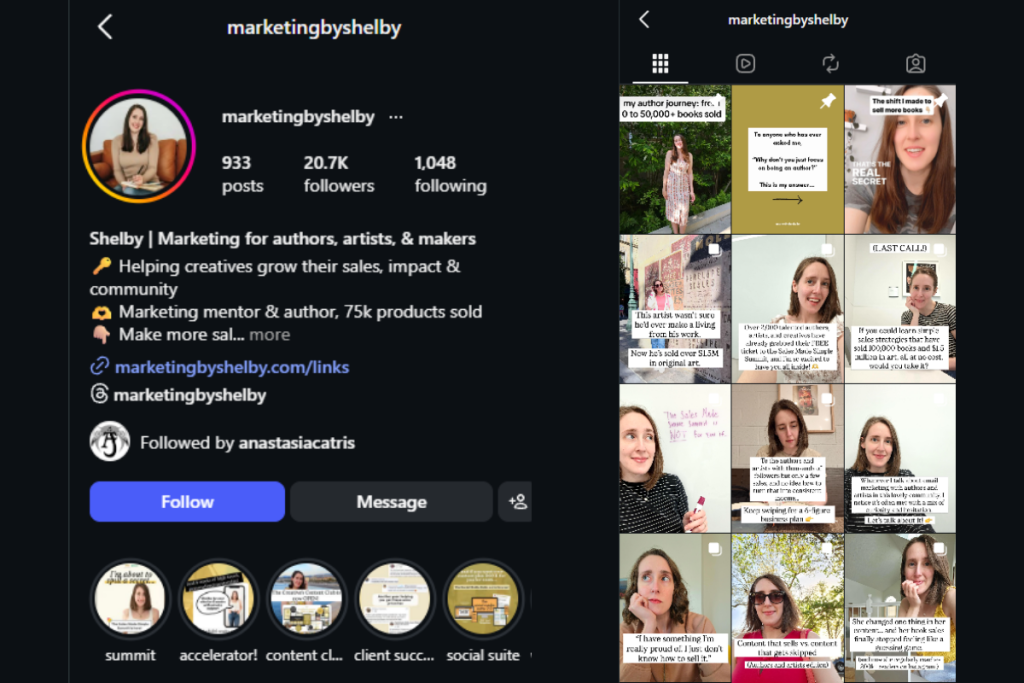
Shelby Leigh, @marketingbyshelby, has grown her audience to over 20k on Instagram as an author who loves to talk to other authors. She had a marketing background, and put it to use finding the best ways to market and sell her own books. When she realized she was pretty good at doing that, and many authors were struggling hard, she started Marketing by Shelby and she’s now one of the first names indie authors think of when they want to know more about marketing their books. Here’s what she had to say about content for authors on Instagram:
“I like to rotate between a few different types of content that help with visibility and reaching new readers, that help with engagement, and that also helps me sell books, which is what I'm on Instagram for as an author. The first type of content that I like to share is content that really speaks directly to my target audience and lets them know I write the types of books that they're looking for or help with the type of situations that they're looking for help with. I also like to share storytelling content where I get a little bit personal related to the themes and topics in my work. This is really the type of content we're seeing perform well for authors because it's really easy to be faceless and generic on social media, but what's really powerful is being vulnerable and personal. So readers feel like they're really connecting with you and building a relationship. (By personal, I mean to whatever extent is comfortable for you, of course!) Lastly, we also want to share sales content in an engaging way. So coming up with some strong hooks and summaries of our books to leave our viewers off on a cliffhanger and get them excited about what's coming next and also behind-the-scenes updates of what we're working on, what we're writing, scenes we decided to delete, or characters that we completely changed. These types of stories are really engaging for our readers.”
Best Practices for Authors on Instagram
Coming up with a list of best practices for authors on Instagram is hard because, as much as we wish there was a direct 1-2-3 line to success, there really isn’t. Just like there are a million different ways to write a book, and the only really wrong way being not to write it, there is similarly an infinite number of ways to approach Instagram.
Quick flashback anecdote for you. I am part of a bookclub. We’ve been reading 1-ish book a month for almost a year now, and we meet every Wednesday night to gush about the we’re reading together, as well as books and life in general. We pick the books based on a variety of factors which can be summed up to “mood.” A few months ago, one person asked: “Have you seen the Instagram account where…” and the rest of us immediately piled on with exclamations and laughter and declarations of love.
What was that Instagram account we each independently discovered and adored? @leewriter19. I’m sure author LeAnna Ehrsom isn’t the perfect author for everyone, but she perfectly appealed to our book club. In writing this post, I slid into her DMs to ask if she had any tips for authors who are trying to find their audiences and connect like she does so [seemingly] effortlessly. When it came to strategy, here’s what she had to say:
“Be creative. We see the same things over and over. And if you find something that attracts an audience, find ways to recreate it.”
That sounds pretty simple, but it is not easy. And that is the reality of Instagram. If I had to offer very specific “Do this not that advice” there are few things I’d include on the list:
- Do keep at it. Post when you can, more is better, but only to the level that comes before you hate everything and cry. Everyone has their own threshold.
- Don’t give up. If it hasn’t worked yet, you just haven’t figured out your own sweet spot.
- Do or don’t use scheduling tools. Some experts say posts that are scheduled have reduced exposure, but I’m pretty sure they get better exposure than the posts that don’t ever get posted. Do what works for you and experiment with new strategies when you can.
- Do try different styles. I haven’t come across a single account that tried one post, went viral, and did nothing else but that type of post forevermore. Start with whatever feels most natural—a casual chat to the camera, a carousel you whipped up using Canva, a photo with some text over it made in the Instagram app itself. Try it out. Then try something else. Stop doing what you hate, do more of what didn’t traumatise you.
- Don’t pin your self-worth or all your hopes and dreams on Instagram. What happens on Instagram matters only so much. It can be a great addition to your marketing efforts as a career author, but it does not define you or our book or the limits of your success. The more you let loose and just try to enjoy yourself, the more your audience is likely to connect with you.
#Hashtags
There is a lot of conflicting information about the use of hashtags, largely because policy and practice has changed a lot. You can use up to 30 hashtags but the current consensus is that 3 - 5 works best. In fact, this is straight from Instagram’s Creators account: “Instagram will gradually update the number of hashtags that you can include in a caption for a reel or post to 5.”
This new restriction is already starting to roll out and if we’re all being honest with ourselves, adding 30 hashtags feels spammy.
There are studies on millions of accounts that show using 0 - 5 hashtags actually gives you the best reach per post.
I know you want the algorithm to find you, but it can read your captions now. It doesn’t need the hashtags and, honestly, most Instagram users are relying on the algorithm to show them the type of content they’ll like, not actively searching hashtags. So spend your time on scroll-stopping graphics and writing a caption that speaks to the audience you want to attract.
If you still want to add a few hashtags, when your caption is written, type # and enter a word that accurately describes the focus of your post and see what comes up. If you’re branding, you can use #authorname, because your fans might actually search that. If you’re promoting something and want to encourage the use of a specific hashtag, go for it! But don’t pin all your searchability responsibility on the hashtags, write a great caption instead.
We’ve created a hashtag generator that can help you stay focused. It only gives you 5 suggestions, based on a series of prompts to help you align with your audience, establish branding for yourself, and match your strategy based on your current followers.
If you really want to add those hashtags, focus on matching your intent over expanding your reach. Try out The Bookshelf’s Instagram Hashtag Generator for yourself!
Instagram Resources for Authors
The best and first resource I recommend for you is Instagram search. Go follow, lurk, stalk, browse, and save posts. See what you like, brainstorm ways to make it your own. See what’s working for others, brainstorm ways to make it your own. See what makes you cringe and brainstorm ways to never do that!
Once you’ve done that, I recommend just experimenting. Try stuff out and use yourself as your own guinea pig.
If you need more guidance after that, here are some of my personal favorite Instagram educators:
- Marketing by Shelby (clearly I had to mention her first). I’ve not gone through her training programs (yet) but her free content has great advice, so I can only assume her paid courses are quality as well.
- Lemon Friday - I first saw Lara on a summit years ago. I’ve since personally invested in all her Caption Kits and I adore her Instagram account. She’s dedicated to authors, loves Schitt’s Creek memes, and is nothing short of an absolute pleasure.
- instagram.com/creators - this is an account by the creators of Instagram, helping creators on Instagram get the most traction possible. Go straight to the source!
- Modern Millie - not exclusively Instagram focused, Millie helps with content creation across platforms.
- Build Your Tribe - I do a lot of learning on YouTube, and this is the first channel I turn to when I want to check on what’s working for Instagram at any given moment.
This is by no means an exhaustive list and I reserve the right to update any time, but I hope it gives you a helpful place to start.
Is Instagram Right for Your Author Business?
If you like Instagram, you can use Instagram. If you found all the advice in this article overwhelming and you don’t resonate with any of it, Instagram might still be right for you if you want to use it.
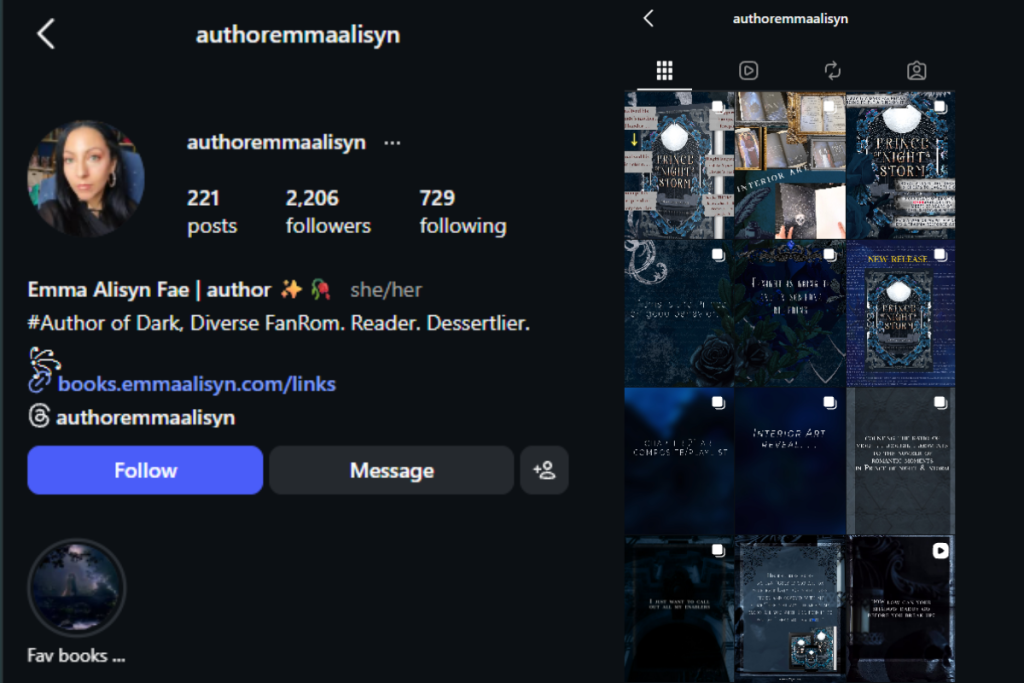
If you do not want to use Instagram, then it is not right for your business. You get to make this decision and find the solution that works best for you. In speaking to authors who are doing well on Instagram, one of my favorite pieces of advice received came from Emma Alisyn, author with multiple pen names and author support at BookFunnel:
“Lololol. Giiiirl. My instagram tip would be, f- it just post something. Lol. I have five children, I work full-time for bookfunnel which I absolutely adore, and I’m trying to do this author thing which I’ve been doing for 11 years. And 11 years has told me, f- it just do what you can. ( but what my coach Chris Downing would say in a more intelligent way, is that momentum is everything. Not perfection. And the breaking momentum when you’re trying to do social media is the kiss of death)”
From what I can tell, the more you post, the easier posting becomes. Practice leads to comfort and consistency will eventually lead to results. Every account will grow at its own pace in its own way. Instagram can be a great long-term organic marketing solution, but it will take effort over time.
Common Pitfalls for Authors to Avoid on Instagram
My background is in sales and marketing. The last decade or so has been spent in the publishing industry, but the things people do wrong most often happen in all industries, all the time. It’s usually because of being nervous or feeling inadequate. Like, “why would anyone want to follow me?” Or, ironically, the fear of being too salesy becomes the self-fulfilling prophecy of being too salesy.
In my research, I came across a few common things on accounts that weren’t performing quite as well as some others I’ve shared in this article. I am not going to call anyone out by name in this section because that’s just rude. We all make mistakes when we’re learning! But we can all learn from each others mistakes as well, right?
Here are some Instagram Icks I discovered that you might want to subvert in your own accounts.
- Quitting. If there’s one thing that all the most successful accounts have in common is that they’re still at it. I promise, their first hundred posts did not do as well as their thousandth posts, but they kept at it. The authors who I noticed stopped posting a few years ago, they’re growth stalled too. Quitting is not a way to succeed on Instagram.
- Isolating. The world collectively went through a major period of physical isolation, so I understand the hesitancy to reach out and talk to strangers, but it’s a skill the world collectively needs to relearn. Yes, there are some authors with huge accounts who rarely comment and engage with their followers and communities, but if you’re reading this, you’re probably not one of them. You probably don’t come with a mass of raving fans who just want to hear you speak or see your furry/plant baby and don’t expect you to know they exist. But the rest of us need to be engaging. If you don’t have followers yet, or engagement on your posts, you need to be a good citizen of Instagramopoly and comment on other accounts. Accounts where your readers might be lurking and commenting and noticing the witticisms you add and come to stalk you. If you do have followers and they are commenting on your posts, please thank them! Reply to them. Get over your fear of small talk for a few minutes each day and be a real person, not just a name.
- Megaphoning. The“Extra, Extra, read all about it” headlines that are capturing the attention of Instagram scrollers are not the ones selling your book. I’m sorry, they’re just not. If all you’re doing is telling people to buy your book, you’re committing a marketing faux pax and doing yourself a huge disservice. If you figure out the “what to post” part well, you will never have to worry about this because, instead, what you’ll be sharing is reasons for your reader to come to the decision to buy your book all on their own. Without being told 218945734 times. Can you tell them sometimes, sure! Absolutely! Please do. But sprinkle it in amongst posts telling them why to by, what they’re buying. Or at least with the content explaining what and why.
Remember @marketingbyshelby? She also had some advice for us on pitfalls authors often fall into.
“A couple pitfalls to avoid are one, not being social on social media. If you expect engagement and new followers and people to be interested in you, but you don't engage with others or connect with others on the platform, growth is going to be slower. Get your name out there and engage with the community because there are millions of readers who would love to have an author comment on their posts. Another common pitfall to avoid is only posting sales content or only posting personal content that has nothing to do with your work. Only sales content can lead to slower growth because readers aren't wanting to follow along to hear from you and up behind the scenes and all of that, whereas only posting personal updates can mean that you're not really making sales from your efforts because your readers don't realize that you have things available to buy. An even mix of these types of posts is really helpful.”
After coming to my own conclusions on the pitfalls, I read the wisdom shared by @leewriter19 and had a quiet moment of, “Yes. This. Correct.” Here’s her take:
“As an author, try not to fall into the pitfall of other author drama or giving fellow authors bad reviews. Those are your coworkers now. And try to find a balance of promoting your book or writing; if all of your content is about your books and your writing, you’ll lose people. Talk about other writers (positively), being a reader, funny posts about books and characters to keep it fresh. Building community will require investment in that community. If you’re only talking about yourself, that’s not community- that’s a podcast. And have fun!
To Sum It All Up
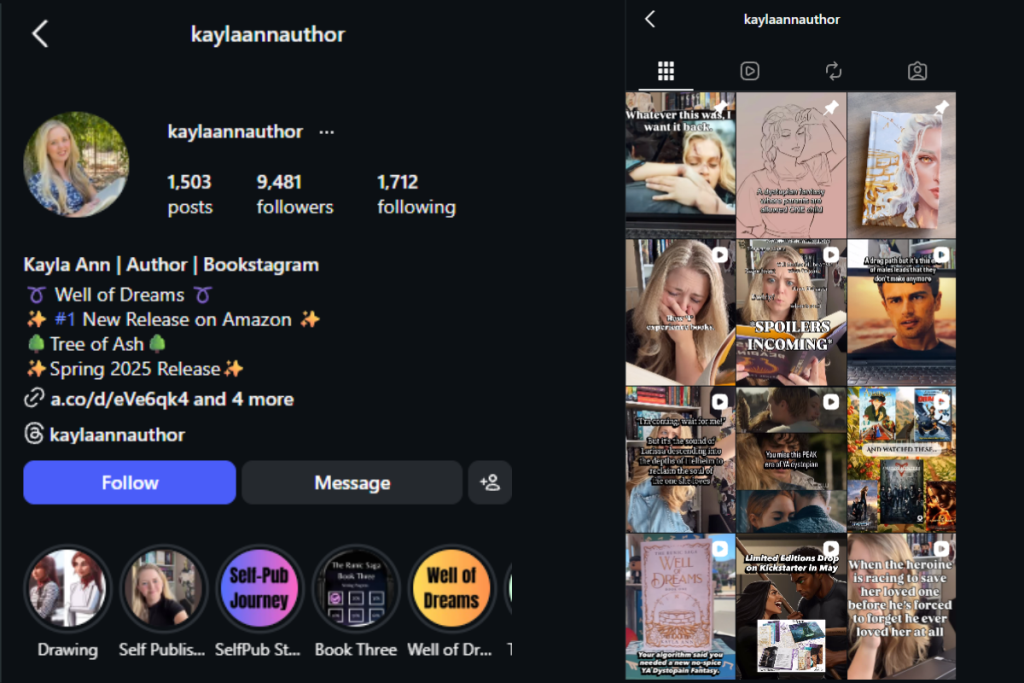
You will know when you come across an Instagram account that speaks to you, whether you’re a reader resonating with the content vibes or an author attracted to the aesthetic inspo. The first post I saw on Kayla Ann’s feed hooked me so completely I forgot I was working and rushed to buy her book. In proper social media speak, IYKYK (If You Know You Know). I reached out to see if she had any advice to share and she replied: “Honestly, my biggest encouragement would be to find your community, create consistent routines, pair up with accountability partners and stop comparing yourself to others 🩵”
If you’re serious about growing a community of readers, and Instagram feels like a platform you can work with, it’s going to take time. You’ll try a lot of things before you discover what resonates with your perfect readers and feels good to post. I’ve shared some examples of authors who have discovered their sweet spots, but if you’re just starting, you can use their accounts as inspiration, motivation, proof that it can be done. But please don’t look at these accounts, compare them to your 75 posts made over the past 2 years and expect their results (full disclosure, I’m referencing my own account).
I like Instagram. I use Instagram personally. I’m determined to find my own sweet spot but I understand it will take some time. If you’d like to join me and a wonderful community of your fellow authors working on their Instagram dedication, we have a free Readership Growth Program to share wins, frustrations, and plenty of things to try.
Related Questions
Can you tell if someone searches for you on Instagram?
No, Instagram doesn’t provide information or data on people who search or land on your profile. The only way you’d be able to see who was visiting your account would be if they interacted with your content, such as leaving a comment, liking your posts, or sharing your post to their stories.
How do I add links to Instagram posts?
You cannot add links to your Instagram posts, either in the image or video itself, or in the caption. Instead, you can have a single link in your bio that you reference. Many authors will use a Link in Bio service to add multiple links instead of just one. You can also use services like ManyChat to encourage your community to leave specific comments that trigger actions, like sending a reader magnet, for example.
One other workaround is to share your post to your stories. When you’re creating a story, you can add a sticker, find the Link icon, and include a link this way. The big downside here is that stories are only available for 24 hours, so this is for engaged viewers only!
Is Instagram Automation Allowed?
Yes, you are allowed to automate your posts for Instagram, but you must use one of the scheduling apps that Meta, the company that owns both Instagram and Facebook, has approved. There are many, with various features and abilities, so you’ll want to do your research before signing up with any tool.
