

An author website is no longer just a digital business card. It’s the foundation of a sustainable writing and publishing career.
Whether you’re publishing your first book or managing a growing backlist, your website is the one place you fully own, control, and shape for your readers. But knowing what an author website should include can feel confusing, especially with so much conflicting advice online.
This guide is designed to cut through that noise. It walks through what modern author websites are really for, how they support your goals, and how to build one that grows with your career, all without requiring you to become a multi-faceted tech expert.
Who This Guide Is For
This guide is for authors who want a website that does more than simply exists; it works for them. Whether you’re a
- debut author setting up your first online home
- indie author managing a growing catalog
- a traditionally published author looking to strengthen your connections with readers
…this guide is built to meet you where you are.
It’s especially helpful if you’ve felt overwhelmed by technical advice, unsure which best practices actually matter, or frustrated by one-size-fits-all website building platforms and templates. You don’t need to be a designer, developer, or marketer to benefit from this guide. You just need to be an author who wants clarity and confidence as they work on a website that can grow alongside their career.
1. What Is an Author Website?
This may seem like a silly question, but we promise it’s not. That’s because the use-case for author websites has shifted so dramatically over the last few years that it’s become necessary to redefine what they actually are, and why they matter more than ever.
For a long time, author websites were treated as checkbox items; just something that you’re supposed to have, even if you weren’t sure why. A simple page with an author bio, a book cover or two, and maybe a few retailer links was considered enough. But the way readers discover, follow, and support authors has changed, meaning the role of an author website has changed too.
Today, an author website isn’t just a place readers visit once—it’s the central hub that everything connects back to. It’s where readers learn who you are, explore your books, decide whether to trust you, and choose how they want to stay connected. And unlike social platforms or third-party marketplaces, your website is the one space online that you fully own and control.
Understanding what an author website is today, rather than what it used to be just a few years ago, is the first step in building one that actually supports your career. Before talking about pages, design, or discoverability, it’s important to start with why your website matters, and what role it plays in a modern author ecosystem.
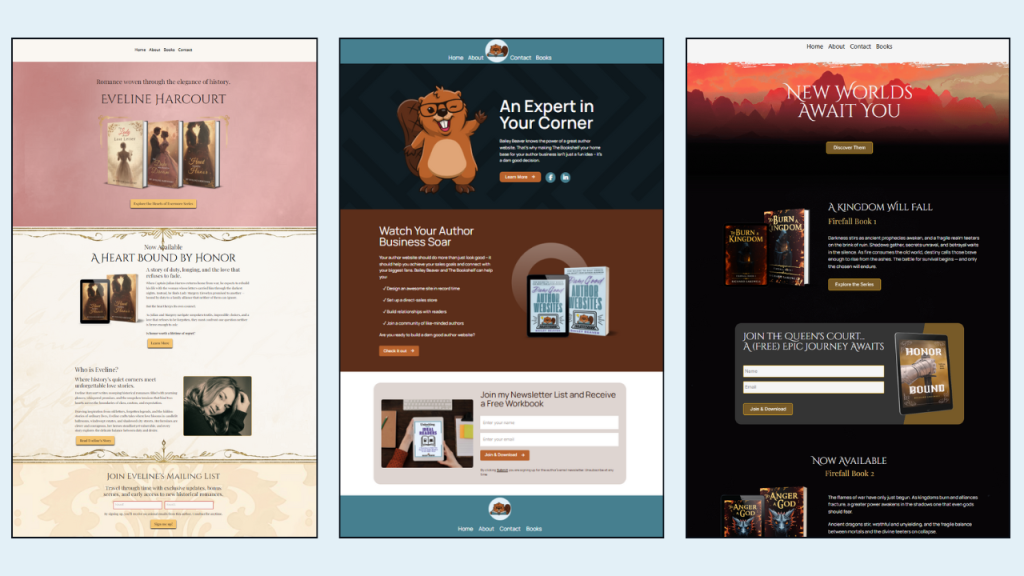
The Evolution of Author Websites
Author websites have changed significantly over the years, but many authors are still working from outdated assumptions about what their website should do. Understanding how author websites have evolved helps clarify why they matter so much in today’s publishing landscape.
Early author websites were just simple and static; a means to exist online. Most included a short author bio, a basic list of published books, and generally little to no ongoing updates. These sites functioned like digital brochures, supporting traditional discovery through publishers, retailers, and media rather than driving discovery themselves.
As online discovery expanded, author websites began playing a more active role. Blogging platforms, email newsletters, and social media changed how readers interacted with authors. But even then, websites were often treated as secondary tools to faster-moving platforms.
Today, author websites serve as the central hub of an author’s online presence. Reader behavior and discovery channels have shifted again, so they now find authors through:
- Search engines like Google
- AI-powered recommendations like ChatGPT
- Direct links shared in newsletters, social media, and podcasts
In this environment, a modern website is no longer optional. It’s foundational. A well-structured author website now supports:
- Discoverability through SEO and GEO
- Reader trust and creditability
- Long-term audience ownership and stability
This evolution doesn’t mean author websites need to become complicated or overwhelming. The goal here isn’t to chase every new tool or algorithm. It’s to build a clear, reliable home base that grows alongside your writing career.
Why Social Media Can’t Replace Your Author Website
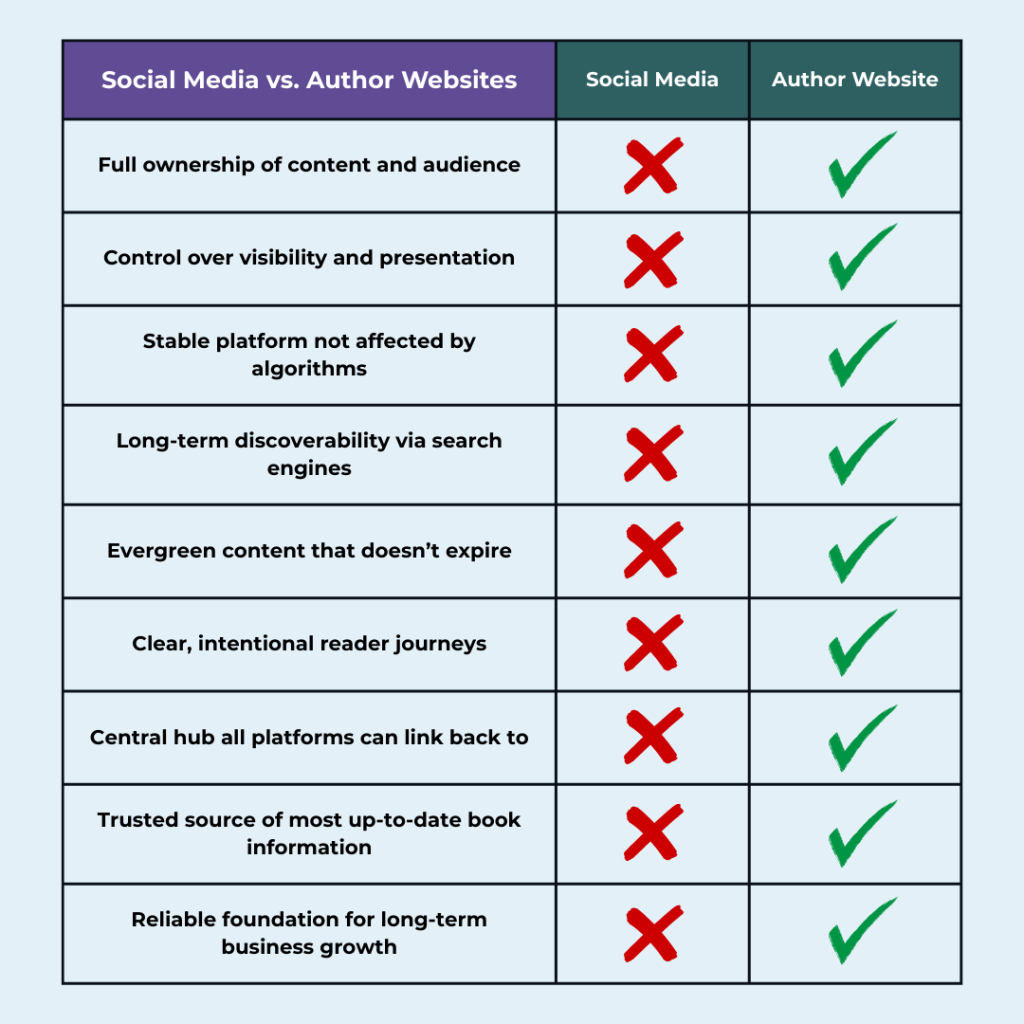
Social media platforms can be great tools for visibility and connection, but they aren’t designed to serve as an author’s long-term home online. While social platforms help authors reach new readers, they come with limits that make them unreliable as the foundation of an author website strategy.
The biggest difference is in ownership and control. On social platforms, algorithms determine who sees your content, meaning reach can change (often without warning). This can filter or restrict your audience access in harmful ways.
Social media platforms also prioritize short-term engagement, not discoverability. Content is designed to disappear quickly, favor trends over evergreen value, and push you to pay for visibility that may or may not work.
By contrast, your author website is fully yours to control. It also supports long-term discoverability through search engines and AI-powered tools, and acts a stable home base by providing:
- A trusted source of information about your books
- Clear pathways for readers to explore your work
- A central hub all platforms can link back to
Social media supports visibility, but your author website provides stability, ownership, and longevity for your writing career.
Author Websites as Long-Term Career Assets
An author website isn’t just something you build once and forget. It’s an asset that gains value over time. It’s meant to become more useful with every book you publish and every reader who discovers your work.
As a long-term asset, an author website supports:
- Ongoing discoverability through search engines and AI tools
- A complete, organized view of all your books
- Reader trust through consistency and professionalism
- Flexibility as your goals or publishing paths evolve
Your website isn’t vulnerable to algorithm changes, platform shutdowns, or shifting policies. Content you create today can continue working for you for years down the line.
All these shifts make one thing clear: an author website works best when it’s built with intention, not assumptions. That next means defining what you actually want your website to do for your career.
2. Defining the Purpose of Your Author Website
Before you start designing pages or writing content, it’s important to get clear on why your website exists in the first place. The previous section detailed the reasons why a good website is important, and the criteria it generally needs to meet, but your author website can serve many roles. The thing is, trying to do everything at once can dilute its impact.
This section will help you identify the primary goals for your site, align them with your career stage, and make intentional choices that set your website up for success.
Common Goals of Author Websites
Every author’s website should have a clear purpose, but most sites serve a few core goals that support a long-term writing career. Understanding these common objectives helps you design pages and content that better help you accomplish the goals your business currently needs.
Most author websites focus on goals like:
- Presenting your catalog in an organized and enticing way
- Capturing email subscribers and providing a hub for loyal readers
- Helping new readers find your work via SEO and GEO
- Sharing your bio, accolades, or media mentions to build credibility
By identifying which of these goals matter most for your stage as an author, you can make more intentional choices about your site’s structure, content, and functionality.
And while it’s okay for your website to serve multiple purposes, catering to a central goal—which can change over time—makes supporting your author business even more effective.
Aligning Your Website With Your Career Stage
Your goals for an author website can (and should) look different depending on where you are in your writing journey. A site for a pre-published author will look and function differently from a site for a debut author, and different still from an author with a large backlist and loyal reader base.
Consider your career stage when planning your website:
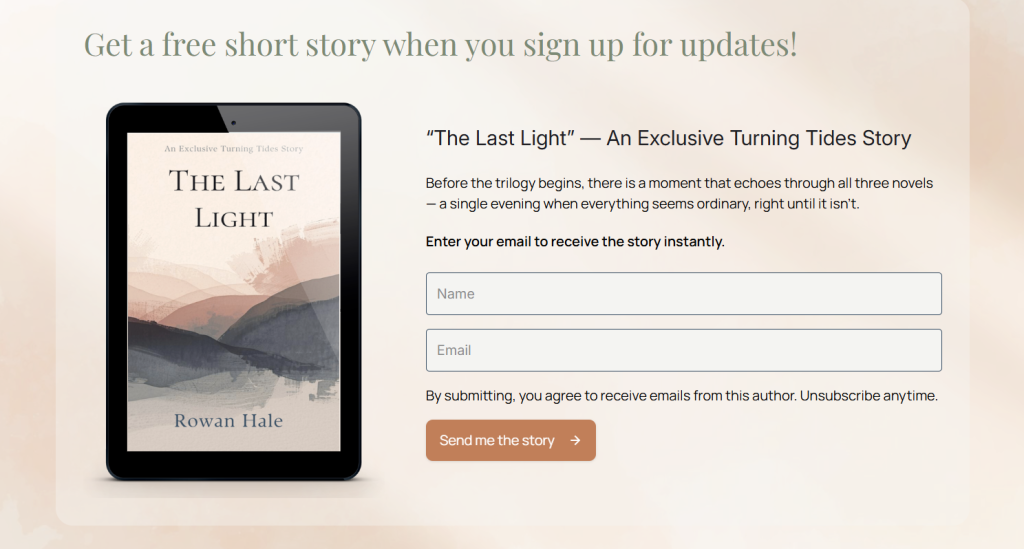
- Pre-published authors: Aim for starting an email list, showcasing yourself, and creating the beginnings of a professional online presence that can grow with you.
- Debut authors: Focus on presenting your first book, continuing to grow your email list, and providing reader connection.
- Authors with a growing catalog: Highlight your backlist, improve discoverability, and make it easy for readers to explore your books.
- Authors with multiple genres or pen names: Organize your site to clearly separate different writing identities and keep navigation to each identity simple and easy.
By tailoring your website to your career stage, you ensure it meets both your current needs and sets the foundation for growth over time.
Avoid “Pretty But Pointless” Websites
It’s tempting to focus on flashy designs, animations, or trending fads. But a website that looks good but doesn’t serve readers or your goals won’t help your career. Every element on your site should have a purpose, supporting discoverability, trust, or engagement.
To avoid a “pretty but pointless” website:
- Prioritize content that serves readers. Book pages, about pages, and contact or newsletter forms should be clear, organized, and easy to navigate.
- Keep design straightforward and functional. Clean layouts, readable fonts, and mobile-friendly design help readers focus on your work, not on the bells and whistles.
- Focus on clarity over trends. Avoid overloading any page, but especially your homepage, with too many calls-to-action, animations, or sales gimmicks (unless it’s specifically a sales-centric page, such as your storefront, product pages, or a sales landing page).
- Support long-term goals. Each page should contribute to visibility, audience growth, credibility, or sales—if it doesn’t, reconsider including it.
- Ensure your website is easy to update. A site that’s difficult to maintain will quickly become outdated. The less pomp and flare to maintain, the more you’ll do necessary updates.
A successful author website balances form and function. It looks professional and intriguing, but more importantly, it helps readers discover, connect with, and trust you.
With a clear understanding of your website’s purpose and your career stage, you can make intentional choices about structure, content, and design. This includes the essential pages most author websites need to serve readers, showcase your work, and provide credibility.
3. Essential Pages for Author Websites
An effective author website isn’t about having more pages—it’s about having the right pages. Each page plays a specific role in helping readers discover your books, understand who you are, and decide how they want to engage with your work. When these pages work together, they create a clear, intuitive experience that builds trust and supports long-term discoverability.
There are often a set of core pages that most author websites need. It’s important to understand what each of those pages is for and how they support both your readers and your broader goals. This way, whether you’re building your first site, refining an existing one, or even if you’re pre-published, you’ll know you’re creating a strong foundation.
Your Author Homepage
Your homepage is often the first page readers see, which makes it one of the most important pages on your website. Its primary job is to quickly show visitors what you write, who you are, and where to go next, but without overwhelming them.
At a minimum, a strong author homepage should:
- Clearly identify the genre or focus of your books (this can be achieved by overall design or strategic book cover placement)
- Showcase your most important book or series (this should change and grow as your career does)
- Offer an easy way for readers to stay connected with you (most often a newsletter sign-up or social media information)
- Optional: Introduce you as the author (not always necessary for the homepage, depending on where you are with your author career)
Each section of your homepage should include a specific call to action. For example, your offer to stay connected could include a sign-up form for your newsletter. Showcasing your most important book could include a “Buy Now” or “Learn More” button next to the book.
Rather than trying to include absolutely everything, your homepage should guide readers toward the next step you want them to take. This is why the central goal you’ve decided you want your website to serve should be featured in the very first section on your homepage.
Book or Product Pages That Serve Readers
Your book pages—the pages that showcase an individual book, which can also function like product pages—are where reader interest turns into real engagement. These pages should make it easy for visitors to understand what each book is about, where it fits in your catalog, and how to take the next step, which is hopefully buying it.
Strong author book pages should:
- Clearly present the title, cover, and format options
- Show series order when applicable
- Include a compelling, easy-to-read description
- Link to related books or other books you have to offer
- If selling direct, display each format’s pricing
Rather than treating book pages as simple listings relying on just the cover image to tell the reader what they need to know, think of them as comprehensive reader guides. Well-organized book pages improve discoverability, reduce confusion, and encourage readers to either buy or explore more of your work.
About Pages That Build Connection
Your author About page is one of the most visited pages on your website, and it plays a key role in building trust with readers. While it’s often treated as a biography, a strong About page does more than list credentials; it helps readers understand and connect with the person behind the words.
An effective author About page should:
- Clearly introduce you as an author and what you write
- Share a bit of your story in a reader-focused way
- Establish credibility without overwhelming detail
- Reinforce your author brand and voice
- Include a call to action, such as exploring your books or connecting on social media
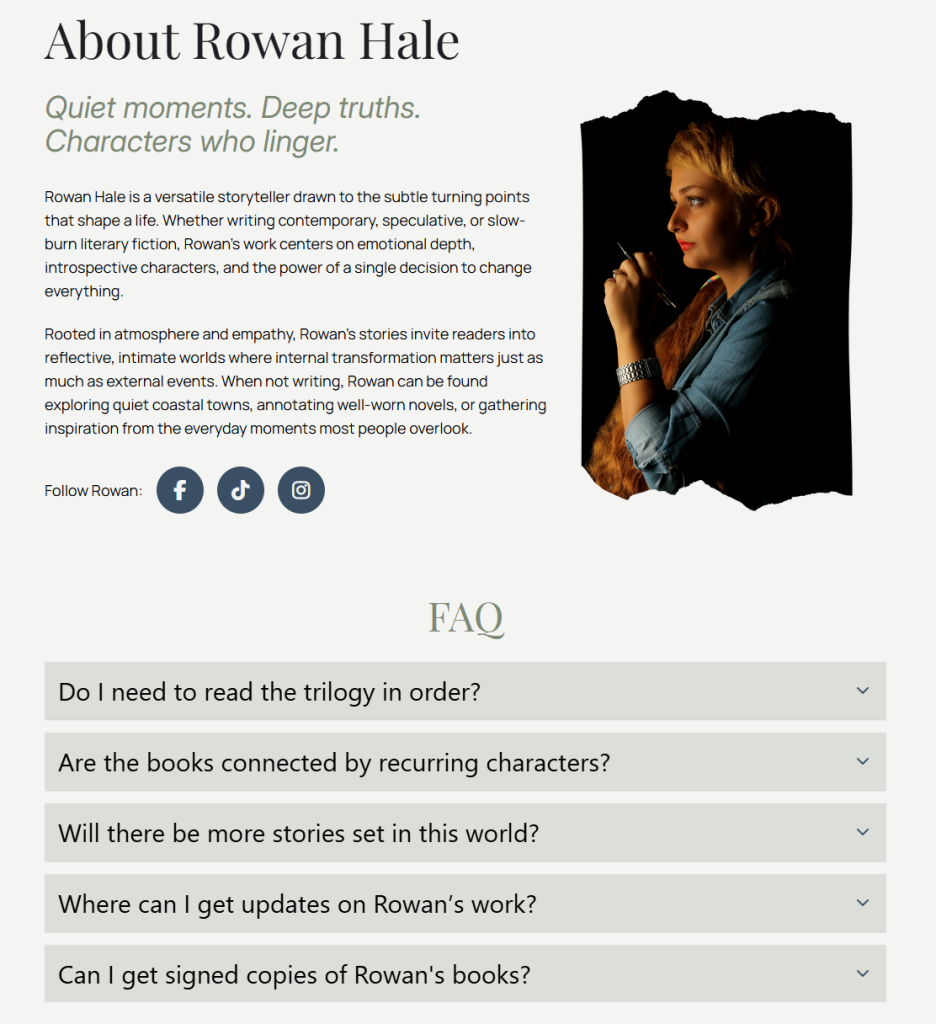
The goal isn’t to share everything about yourself, but to create a sense of connection, confidence, and memorability. When readers feel like they know who you are and why you write, they’re more likely to trust your work and keep exploring your site.
Contact, Media, and Supporting Pages
While they may not get as much attention as homepages or book pages, contact and other supporting pages play an important role in making your author website feel complete and professional. These pages help readers, media, and collaborators know how to reach you or any other important information you’d like to share.
Common supporting pages on an author website may include:
- Contact page: Clear ways for readers, event organizers, or professionals to get in touch with you.
- Media or Press page: If you’re keen on being featured in other places by people in the media, then provide a media-specific author bio, book summaries, or even downloadable press kits. Links to previous media features can also be included here.
- FAQ or Resources page: Answers to common reader questions or helpful links to additional information. These can also be featured on your About or Contact pages.
- World-Building pages: Most common for speculative fiction writers, this is a page that lays out the details of your fictional world, characters, and other information to engage your fans.
- Privacy or Legal pages: These provide transparency and trust about your website and how it operates, especially when collecting reader information.
These pages don’t need to be elaborate or exhaustive, but they do need to match design with the rest of your site and be easy to find and update. Together, they add polish, credibility, and clarity to your site. This makes it even more accessible, trustworthy, and engaging for everyone who visits.
Blogs and Other Ongoing Content
Not every author needs a blog, at least not in the traditional sense. Blogs are often thought of as ongoing diary-like entries with a strict schedule and personal content. But the purpose they often serve is to contribute to long-term discoverability through search engines and AI-powered tools by providing additional content for your site.
For this reason, a traditional blog with all its dating and cataloguing features isn’t always necessary. But it can be a good idea to have some type of ongoing evergreen content to add to your site every once in a while, whether you call it a blog or not.
Ongoing content on an author website can help:
- Answer common reader questions
- Provide more context around you or your books
- Support SEO and GEO with evergreen content
- Give readers a reason to return to your site
Even occasional posts, curated resources, or behind-the-scenes insights can add value when they’re clear, relevant, and easy to update. Then adding clear headings, subheadings, sections, and lists further helps discoverability. But the real key is choosing content you can sustain over time, rather than trying to commit to a schedule that becomes burdensome.
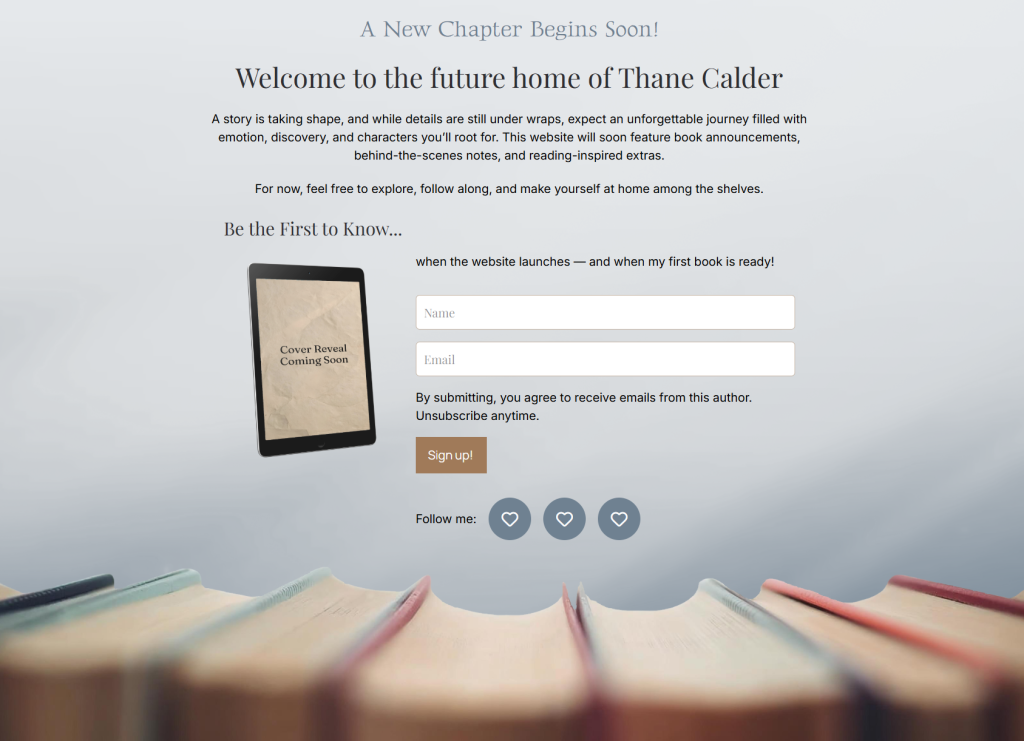
Pre-Published or Single-Page Websites
There are some cases in which it may not be necessary to have a multi-page website with all the pages detailed in the sections above.
If you’re a pre-published author, meaning you’re still working on your first book and will be publishing it soon, you may not have all the materials ready to build out a robust, multi-page website. But that doesn’t mean you shouldn’t still have one.
In this case, it’s just fine to have a more simplified website with fewer pages, or even just a single-page. Your site can be a homepage that simply includes sections of brief information about you, your upcoming book, and a place for readers to sign up for your newsletter. Then, after you publish and your catalogue and fanbase grow, you can develop and add to your website alongside your author career.
4. Your Author Website as Business Infrastructure
An author website isn’t just a creative space. It’s part of the foundation of your publishing business. Even when sales, marketing, or reader engagement may happen across several platforms, your website provides the structure that holds everything together. It’s where information stays consistent, trust is built, and growth is supported over time.
If you think of your authorship as a business, then you should think of your website as an integral piece of your overall business plan. Though you don’t have to do everything at once, preparing your site to support sales, build reader trust, and create a pathway for expansion is the best way to utilize it as a growth tool for your entire author career.
Your Website Is the Foundation, Not the Entire Strategy
Your author website doesn’t need to handle every part of your business in order to be essential to it. Instead, it works best as the foundation that supports everything else: sales platforms, marketing efforts, reader engagement, and future growth.
As a foundation, and author website provides:
- A single, reliable source of truth about your books and information
- Consistent branding and messaging across platforms
- A stable home that isn’t affected by algorithm changes
- Clear pathways for readers to take the next step you want them to take
While social media, retailers, and other tools play important roles, they all work better when they point back to a website you own. By anchoring your presence in a well-structured author website, you create flexibility, allowing individual strategies to change without them undermining your overall business.
If you’d like to learn more about how to build and maintain an author business, check out The Ultimate Guide to Running an Author Business.
Supporting Sales Both Off and On Your Website
An effective author website supports book sales, whether the transactions happen somewhere else or on your site itself. Whether you sell through third-party retailers like Amazon or directly from your own website, your site should guide readers toward the right option.
When pointing to third-party retailers, your author website can:
- Centralize buy links in one easy-to-find place
- Help readers choose their preferred retailer
- Provide context around available formats, series order, or other important details
When selling directly from your author website, it can:
- Create a seamless path from discovery to purchase
- Support exclusive editions, formats, or bundles
- Strengthen reader trust through transparency and clarity
- Open a pathway for direct communication with readers after they purchase
In both cases, your website acts as the decision-making space where readers learn, compare, and feel confidence before buying. You don’t have to include both sales models if you’re not ready to—the goal is just to ensure your website is prepared to support the choices that make the most sense for you and your audience.
What Makes an Author Website “Sales-Ready”
A sales-ready author website doesn’t need complex systems or constant promotion (though it does help to have a way to direct readers to your site if your goal is to sell direct). Instead, you just need to create clarity and confidence for readers, making it easy to move from interest to action, no matter where or how a purchase happens.
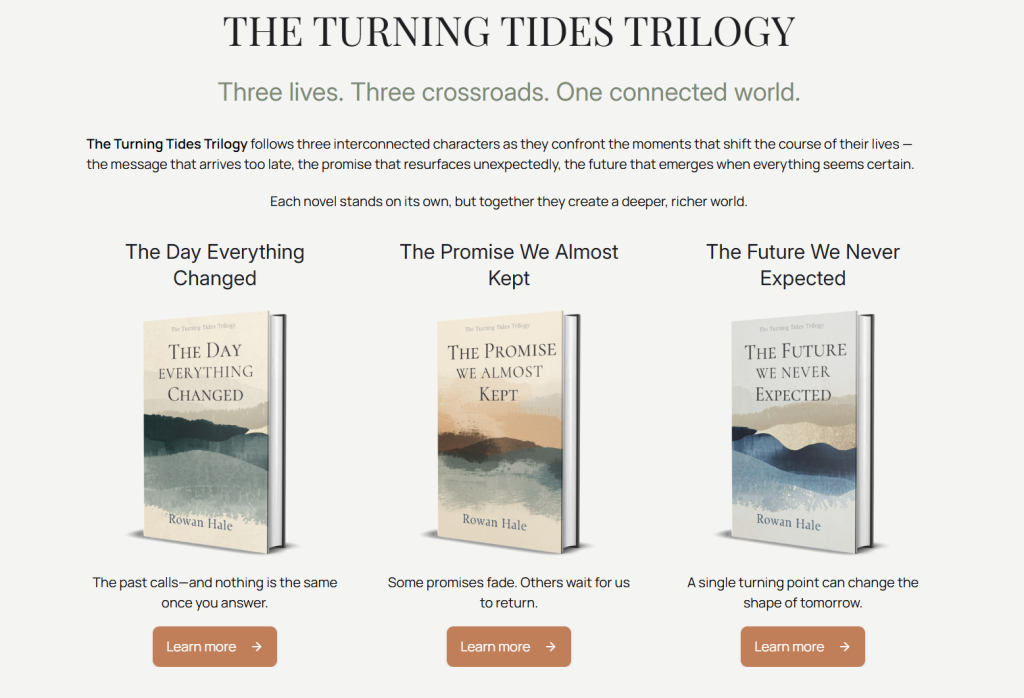
A sales-ready author website typically includes:
- Clear, well-organized book or product pages with up-to-date information
- Obvious next steps or calls to action, such as links or buttons to buy or learn more
- Consistent messaging about your books across all pages of your site
- Simple navigation that helps readers find what they’re looking for in the fewest number of clicks
Sales readiness isn’t about pushing readers to buy—it’s about removing friction and adding value. When your website answers common questions, presents your books clearly, and feels reliable, it naturally supports sales without feeling salesy.
If you’d like to learn more about implementing direct sales on your website and beyond, check out The Ultimate Guide to Selling Books Direct.
5. Author Websites and Reader Relationships
At the heart of every sustainable author career is a strong relationship with readers. While platforms and tools may change, the ability to connect directly and consistently with your audience will always be essential.
Your author website plays a central role in that connection by providing a stable, trusted space readers can return to on their own terms. Through clarity, accessibility, and thoughtful design, Your website can directly support the relationships you’re attempting to build with the readers you send to it. The goal is simple: to use your website as a tool to create lasting connections.
Why Connection Matters More Than Campaigns
Short term marketing or advertising campaigns can drive bursts of attention, but long-term author careers are built on consistent, meaningful connection with readers. An author website supports those connections by offering a stable place where readers can explore your work and engage at their own pace.
Connection-focused author websites help by:
- Giving readers a reliable place to return to
- Creating familiarity and trust over time
- Supporting ongoing discovery beyond launch windows
- Allowing relationships to grow without constant promotion
Unlike fast-moving platforms designed for urgency, your website encourages intentional engagement. By prioritizing connection over campaigns, your author website becomes a space that supports trust, loyalty, and long-term reader relationships.
Your Website as the Center of Audience Ownership
One of the most important roles of an author website is giving you a direct, owned connection to your readers. Unlike social platforms or third-party tools and retailers, your website isn’t governed by algorithms, changing policies, or hidden customer information. It’s a space you control and have full access to.
When your website acts as the center of audience ownership, it:
- Provides a reliable hub where readers know they will get the most accurate information
- Gives readers a way to sign up for your newsletter list and continue engaging with you
- Reduces reliance on any single platform so that you’re not scrambling when things change
This doesn’t mean you should abandon social media platforms or other channels. Instead, it means using them all strategically by pointing readers to a website that serves as the most reliable epicenter of your online presence.
Ethical, Reader-First Communication
Strong author-reader relationships are built on trust, and trust comes from clear, ethical communication. Your author website sets the tone for that relationship by showing readers what to expect and by respecting their choices.
Reader-first author websites prioritize:
- Transparency about how and why readers might be contacted
- Clear explanations of what readers are purchasing or signing up for
- Easy ways for readers to opt in or opt out on their terms
- Respect for privacy and personal data
By focusing on clarity and consent, your website creates a positive experience that readers feel good about returning to. Ethical, reader-first communication isn’t just good practice—it’s long-term investment in loyalty.
Passive Relationship-Building Through Design
Your author website can strengthen reader relationships even without constant messaging or pushing. Thoughtful design, intuitive navigation, and clear content all contribute to a passive yet powerful connection with your audience.
Thoughtful design can support passive relationship-building by:
- Ensuring a consistent, professional touch that communicates your genre clearly
- Organizing book pages and series orders logically for easy exploration
- Highlighting key content and calls-to-action without clutter or confusion
By creating a website that communicates clearly and is easy to navigate, you nurture reader loyalty naturally. Even visitors who don’t immediately engage will leave with a positive impression, making them more likely to return and explore your books over time.
Focusing on connection, trust, and reader-first design makes your author website a reliable hub for building long-term relationships. While external factors like email marketing campaigns, social media, and other engagement channels still matter, your website provides a stable home that strengthens every interaction and ensures readers can always find and connect with you.
If you’d like to learn more about how to engage with readers and direct them to your website from other sources, check out The Ultimate Guide to Author Marketing.
6. SEO and GEO for Author Websites
Even the best author website can’t support your career if readers can’t find it. Discoverability is what connects your work with new readers—whether they’re searching through traditional search engines or finding recommendations through AI-powered tools. That’s where SEO and GEO come in.
But search engine optimization (SEO) and generative engine optimization (GEO) don’t have to be complicated to be effective. The focus should be on clarity, structure, and long-term visibility—not chasing algorithms or technical tricks. That way, your website can be discoverable now, and adaptable in the future.
How Readers Discover Author Websites Today
Readers find author websites in more ways than ever before, and understanding those pathways helps you make smarter choices about your site’s structure and content. Discovery no longer happens in a single place—it’s spread across search engines, AI recommendations, and shared links.
Today, readers commonly discover author websites through:
- Search engines like Google and Bing
- AI-powered generative tools like ChatGPT, Claude, and Gemini
- Links on social media, podcasts, or newsletters
- Mentions on blogs, book lists, and review sites
Because discovery is decentralized, your author website needs to be clear, well-organized, and easy for both people and technology to understand. When your site communicates context and authority, it becomes easier for readers to find no matter where their search begins.
Traditional Search Engines vs. AI-Powered Discovery
Traditional search engines and AI-powered discovery tools help readers find author websites in different ways. Understanding the difference can help you structure your site so it performs well in both environments.
Traditional search engines focus on:
- Keywords and search intent
- Page structure, headings, and metadata
- Links and site organization
- Clear, crawlable content
These systems return lists of results, allowing readers to choose which pages to explore.
AI-powered discovery tools focus on:
- Context and clarity across your site
- How information is connected and explained
- Consistent signals about who you are and what you write
- Well-organized, authoritative content
Instead of lists, these tools often generate answers or recommendations directly.
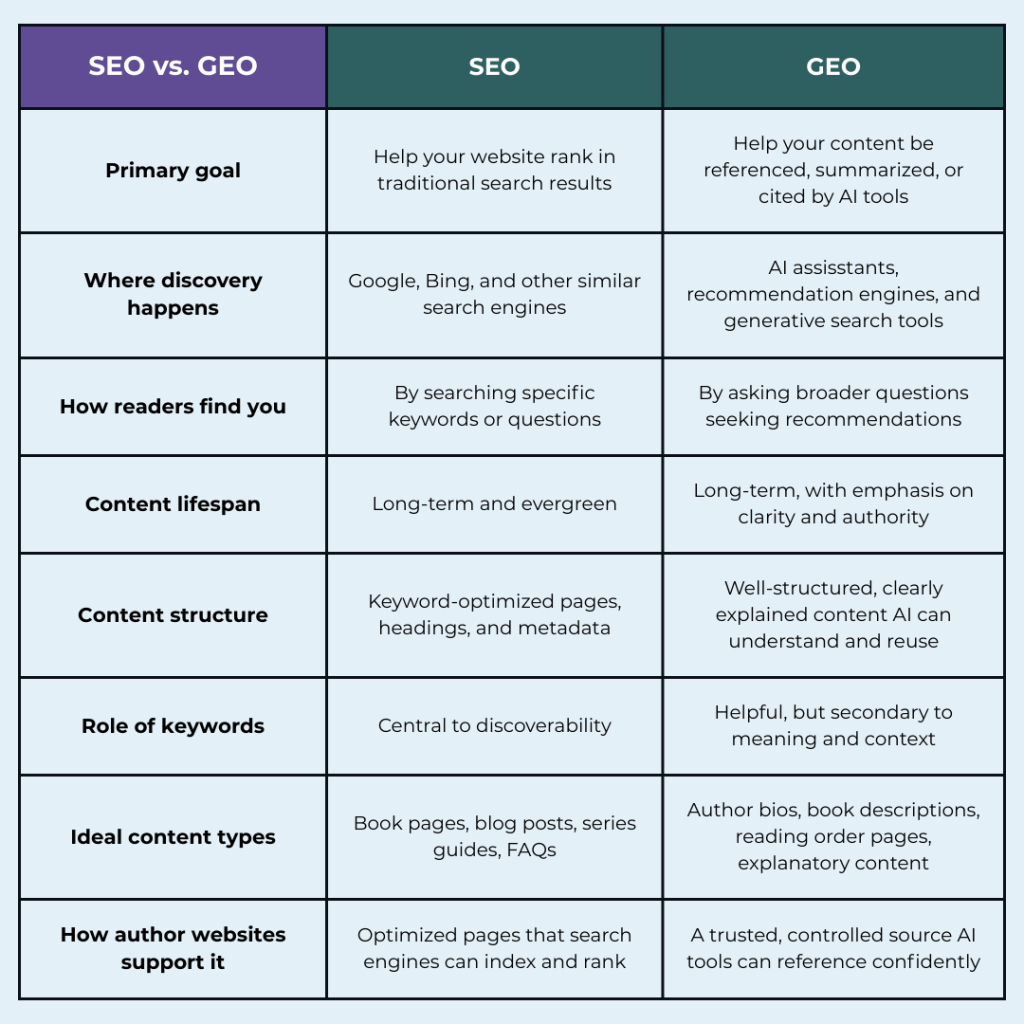
The good news is that author websites don’t need two separate strategies to cover both grounds. Clear structure, accurate information, and evergreen content support both SEO and GEO, making your website easier to find from both ends.
SEO Basics for Authors
Search engine optimization doesn’t have to be complicated to be effective. For authors, SEO is less about chasing trends and more about making your website clear, consistent, and easy to understand.
Strong SEO for author websites focuses on:
- Clear page titles and headings that describe your content
- Well-organized book and series pages
- Consistent use of your author name and genre(s)
- Internal links that help readers explore your site
- Evergreen content that stays relevant over time
Rather than trying to optimize every page for every keyword, focus on accuracy and structure. When your website clearly communicates who you are and what you write, both search engines and readers are more likely to find it and trust it.
What GEO Really Means
Generative engine optimization, or GEO, is the way your website is discovered and recommended specifically by AI-powered tools like ChatGPT. This and other AI platforms are being utilized more and more frequently for book and author recommendations, so you want to make sure your website is showing up in those conversations.
Unlike traditional search engines, which provide a list of links to explore, GEO helps AI read and understand your content so it can generate full, thoughtful answers and suggestions for readers.
For authors, GEO is about making your website:
- Clear and structured so AI can understand your books, series, and topics
- Consistent in how you present your author name, genres, and key information
- Rich in context so AI can connect your work to related reader inquiries
- Evergreen, ensuring content remains useful and discoverable over time.
Notice how optimizing for SEO and GEO share quite a few similarities? By taking both into consideration and working on them side by side, your author website becomes easier to find no matter where readers are doing their searching. Clear organization and accurate content are the key to improving long-term discoverability.
Structuring Author Websites for Clarity, Authority, and Context
How your website is organized affects both human readers and AI-powered discovery tools. A clear structure signals authority, builds trust, and makes it easier for both algorithms and humans to understand your work.
Key elements of a well-structured author website include:
- Logical navigation: Pages and sections that are easy to find and follow
- Consistent labeling: Book titles, series, and genres are presented clearly
- Contextual connections: Internal links connecting related content for readers and AI
- Authority signals: Accurate information and clear author identity and ownership
- Smart organization: One Heading 1 level per page, followed by H2 and H3 as needed, and easily-scannable body text or organized lists.
- Evergreen content: Pages and descriptions that remain relevant over time
By prioritizing clarity, authority, and context, your website not only helps readers explore your work, but also improves discoverability across search engines and AI tools, creating a strong foundation for long-term visibility.
Maintaining and Updating Your Author Website
Building your author website is just the beginning. To remain effective as a long-term business asset, it needs regular updates and maintenance. A well-maintained site keeps information accurate, supports discoverability, and signals professionalism to readers.
Key practices for maintaining your author website include:
- Regularly updating book pages to keep release dates, covers, and purchase links current
- Refreshing content by adding new pages, posts, or other resources as appropriate
- Checking functionality to ensure all forms, links, and downloads work correctly
- Reviewing design and navigation to keep layouts clear and mobile-friendly
- Monitoring performance for speed site, broken links, and SEO metrics periodically
By treating your website as an evolving resource rather than a one-time project, you ensure it continues to serve readers, support discoverability, and act as a stable hub for your business—even as tools, platforms, and trends change.
Maintaining a clear, well-structured, and regularly-updated author website ensures it remains a reliable home for your readers. By combining thoughtful design, discoverability, and reader-focused content, your website supports every stage of your writing career while giving you control and stability in a constantly changing digital landscape.
7. Design, Branding, and Reader Experience
Your website’s design and branding aren’t just about looking good—they communicate who you are as an author and shape how readers experience your work. Thoughtful design builds trust, reinforces your brand, and makes your site easy and enjoyable to navigate.
By combining clean design, consistent branding, and an intuitive reader experience, you can create a website that feels professional, approachable, and aligned with your goals.
Designing for Clarity, Trust, and Usability
A well-designed author website does more than look attractive. It communicates professionalism and guides readers seamlessly to where they want to go. Clear design and intuitive usability helps visitors feel confident, reduces their frustration, and encourages exploration.
Key principles for designing an author website are:
- Simple, consistent layouts: Avoid clutter and organize content logically
- Readable typography: Use fonts, sizes, and colors that are easy to see on all devices
- Visual hierarchy: Highlight important elements like book covers, calls to action, or discount prices
- Mobile-friendly design: Ensure the site works smoothly on phones and tablets as well (most readers these days will discover you on their phone first)
- Accessible navigation: Make menus and links intuitive so readers can find what they need in as few clicks as possible
By focusing on clarity and usability over flashy effects or overly-intricate design, your website becomes a reliable hub that readers can navigate confidently. This supports more discovery, more engagement, and a long-term connection without overwhelming or confusing visitors.
Aligning Your Website with Your Books and Brand
Your author website should reflect not just you as a writer, but also the style, tone, and themes of your books and their genre(s). Alignment between your website and your brand helps readers immediately understand what to expect and reinforces your identity as an author.
Ways to align your website with your books and brand include:
- Visual consistency through using colors, fonts, and imagery that reflect your genre accurately
- Tone of voice through copy for bios, book descriptions, and blog posts that match your author voice
- Genre cues that clearly signal the types of books you write through curated sections on each page
- Covers and other visual assets displayed through book images, graphics, and media that are consistent with your overall branding
- Cross-channel cohesion between your website, social media, newsletter, and any other platforms
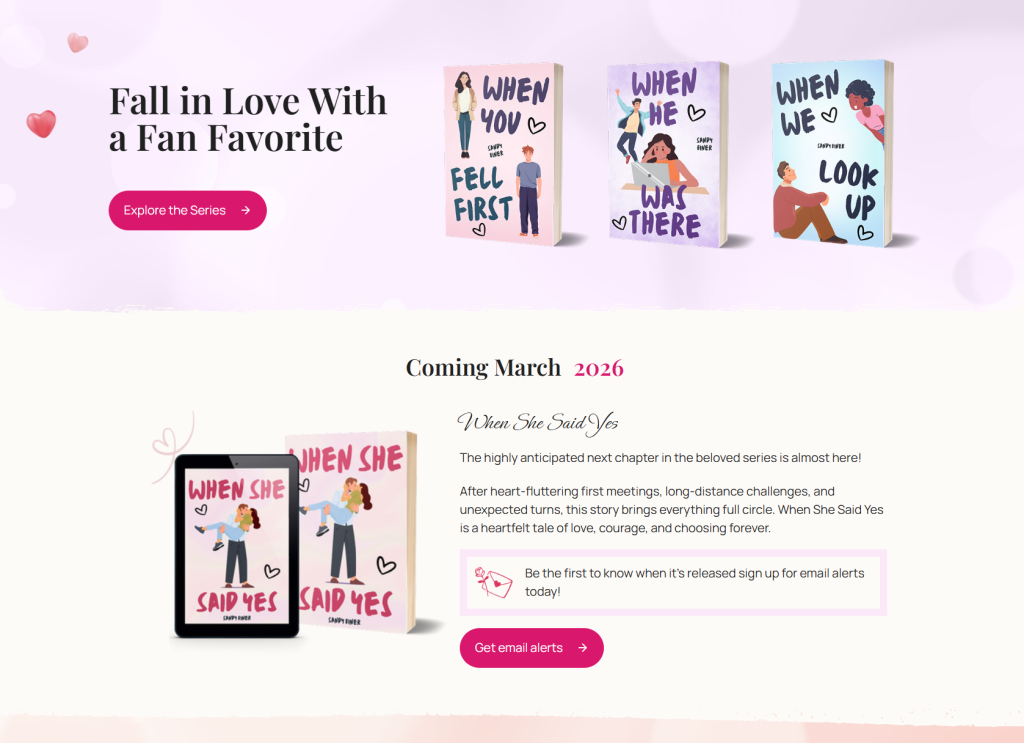
When your website mirrors your books and brand, readers instantly understand your work and are more likely to stay and engage, explore, and return for future releases.
Accessibility and Inclusivity Basics
An author website should be welcoming to all readers. Prioritizing accessibility and inclusivity not only broadens your audience, but also signals professionalism and care, which can even further help to build trust with visitors.
Key accessibility and inclusivity practices include:
- Readable fonts and high-contrast text for easy reading
- Alt text for images that accurately describes them so visually impaired visitors can convey the content
- Operable features and functionalities for users who may need to can navigate your site without a mouse
- Clear headings and structure for consistency and ease of navigation
- Inclusive language that avoids assumptions about any reader’s identities or experiences
Even small changes can make a significant difference. By designing with accessibility and inclusivity in mind, your website becomes a space where every reader can engage comfortably, strengthening both trust and reach.
Mobile-First Reader Experiences
Most readers will visit your author website via their smartphone, which makes mobile-first design essential. A mobile-friendly website ensures readers can explore your books, learn about you, and take action without getting frustrated while on the device they are most likely to discover you on.
Mobile-first best practices for author websites include:
- Responsive design that allows pages to automatically adapt to different screen sizes
- Simple navigation with menus, buttons, and links that are easy to tap and scroll
- Fast load times, achieved by using optimized images and clean layouts
- Readable content with text, spacing, and images that are all clear and legible without zooming in
- Streamlined actions like sign-ups and purchases that are easy to achieve on small screens
Designing for a mobile-friendly reader experience improves usability and engagement while also supporting discoverability across search engines and AI-powered tools.
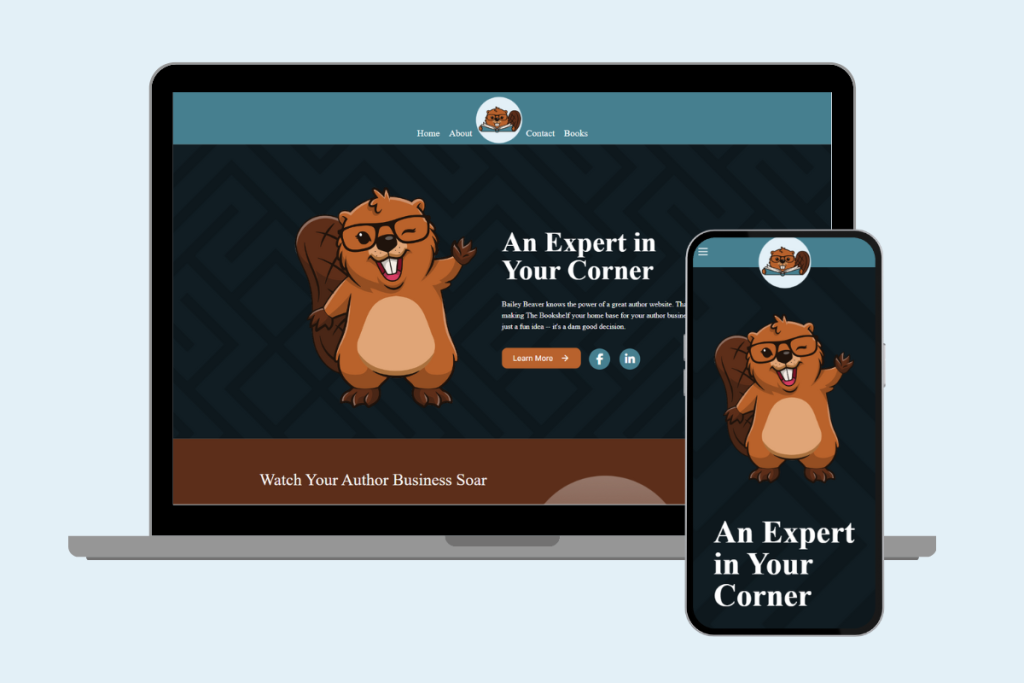
Thoughtful design, consistent branding, and reader-first experiences turn an author website into a place readers enjoy returning to. By prioritizing clarity, accessibility, and mobile usability, your website will support discoverability, engagement, and long-term growth, all while reinforcing your author brand at every touchpoint.
8. Technical Essentials Authors Should Understand
You don’t need to be a tech expert to run a successful author website. But understanding a few technical essentials can save time, reduce frustration, and protect your online presence. The goal isn’t to master the tech, but to make informed decisions that support your author business.
There are a few core technical components about your website that it’s important to understand, but they can be approached with an eye for clarity, stability, and simplicity rather than complexity.
Domains, Hosting, and Security
Your domain, hosting, and security setup form the backend foundation of your author website. These technical essentials affect how reliable your site is, how professional it appears, and how much control you have over your online presence.
Your domain is your website’s permanent address and a key part of your author brand. Ideally, it should be simple, memorable, and tied directly to your author name. Owning your domain ensures you’re not dependent on third-party platforms and gives you a stable home you can point readers to for years.
Hosting determines where your website lives and how quickly it loads for visitors. Reliable hosting improves speed, uptime, and overall reader experience, especially for mobile users. Good hosting also makes it easier to scale your site as you add content, books, or new features over time.
Basic website security protects both you and your readers. An SSL certificate (the “https” portion of your URL) encrypts data and builds trust, while regular updates and backups help prevent issues and recover quickly if something goes wrong.
At a minimum, authors should prioritize:
- Owning their domain name
- Choosing reputable, stable hosting
- Using SSL and basic security protections
- Keeping software and tools up to date
When these essentials are handled well, your author website stays fast, secure, and dependable, creating a strong foundation for everything else you build on top of it.
Author Email Linked to Your Domain
An email address connected to and representative of your domain reinforces professionalism and builds trust with readers or service providers. It also gives you more control over your communication than many free email services.
Benefits of a domain-based author email include:
- Strengthening your brand consistency
- Improving deliverability and trust
- Keeping your author business communications centralized
- Supporting long-term ownership of your audience
Not all domain hosting services provide a free author email with a usable inbox to go along with it, so be sure to check when deciding on a provider.
When setting up your author email, choose something clear for the username portion of the address, such as your first name or “hello”—for example, hello@myauthorwebsite.com. Then you can connect this inbox to things like contact forms on your website, keeping your communication centralized and professional.
Choosing Tools That Reduce Friction
The tools behind your author website should make your life easier, not harder. Choosing platforms and integrations that not only work well together, but are author- or publishing-centric reduces friction for both you and your readers, but should be achievable without adding mountains of complexity to your setup.
When evaluating platforms, tools, and integrations, prioritize:
- Ease of use and clear documentation for setup and learning
- As few plugins or third-party dependencies as possible
- Reliable support documents and real people to help you when needed
- Tools that are built with authors and the way they sell books in mind first
Simple, well-built, and well-integrated systems help you spend less time managing the tech behind your website and more time writing, connecting with readers, and building your author business as a whole.
Having a basic understanding—not expert-level knowledge—of the technical essentials of your website gives you more control, confidence, and flexibility as your author career grows. With reliable foundations like domains, secure hosting, professional email, and low-friction tools in place, your author website becomes easier to manage, and better equipped to support everything you build on top of it.
9. Scaling Your Author Website as Your Career Grows
Your author website shouldn’t be built solely for where you are today. It should be able to grow with you. As your book catalog expands, your audience will change and grow too, and new opportunities will emerge. Your website needs the flexibility to scale alongside these changes without requiring a full rebuild every couple of years.
By designing and maintaining your author website with the mindset that it should easily evolve alongside your writing career, you support long-term growth from day one.
Growing from Debut to Deep Backlist
An author website often starts out simple, but over time, as you publish more books, it will need to be able to support those books as well as more visitors, and include more context. Planning for that growth early makes it easier to expand without confusion or clutter.
Some ways your website can scale with your backlist are by:
- Including clear book and series organization as the number of titles increases
- Dedicating pages for individual books and series
- Providing navigation and calls to action that are easily adjustable as your goals evolve
- Creating space for evergreen content that supports older titles and promotes discoverability
By building your author website with a scalable structure from the start, you make it easier for new readers to discover your growing catalog, explore older titles, and engage with your work at every stage of your author business.
Expanding Sales Avenues, Offerings, and Audiences
As your author career grows, your website will grow to support all the elements you want to make available to your audience, which will also be growing. New sales channels, new book formats or editions, other related merchandise, and new points of entry for your readers to find it all will likely emerge over time.

Scalable author websites are often built to support:
- Multiple retail platforms to link out to, depending on where you make your book available
- Additional formats such as audiobooks, or special print editions that may not have been available initially
- Direct sales and/or bundled offerings sold through your website rather than a third party
- Fun merchandise that goes in hand with your books or series
- Additional reader resources, bonuses, or exclusive content to keep audiences engaged
- Pages set up to accept readers from different entry points, such as landing pages for ads
Building flexibility into your site makes it easier to add offerings without disrupting reader experience. The easier it is to add new sales options, reader experiences, and points of entry over time, the more likely you are to undertake that growth.
Future-Proofing Your Website Decisions
No one can predict how publishing or technology will change—and it certainly will. But your website can be built to adapt to change. Future-proofing is all about choosing tools, structures, and strategies that won’t limit your options later.
Future-proof website decisions often include:
- Owning your domain so you can move it to other platforms if needed
- Keeping reader or customer contact information so you can maintain those relationships
- Building your site on a platform that allows portability and/or exports in case you change providers
- Avoiding the use of multiple platforms and integrations that you might lose or need to set up all over again
- Prioritizing clarity, structure, and evergreen content everywhere possible
When your website is designed for adaptability, you protect your independence as an author. These future-proof decisions ensure your website remains adaptable, sustainable, and aligned with your long-term goals no matter how the industry changes.
Scaling your author website thoughtfully ensures it can support your career not just today, but for years to come. By planning for growth, flexibility, and adaptability, your website becomes a stable foundation that evolves alongside your books, audience, and business goals.
10. Bringing It All Together: Building a Sustainable Author Website
A successful author website isn’t about chasing trends or building something overly complex. It's about creating a clear, reliable home that supports your readers, your books, and your long-term career goals. When the right principles guide your decisions, your website becomes an asset that grows with you rather than being a burden to maintain.
Key Principles to Keep in Mind
Across every stage of your career, the most effective author websites share a few foundational principles. These guide better decisions, reduce friction, and support sustainability over time.
Key principles for sustainable author websites include:
- Clear purpose and defined goals for your site to serve
- Ownership of your domain, content, and audience
- Intuitive page structure and navigation
- Reader-first design and communication
- Flexibility to grow your site with your catalog and offerings
- Simplicity over unnecessary complexity
When these principles are in place, your website works quietly and consistently in the background so it can support discoverability, engagement, and trust.
Common Pitfalls to Avoid
Many author websites struggle not because of lack of effort, but because of avoidable missteps. Knowing what to avoid when building your site can save time, money, and frustration.
Common author website pitfalls include:
- Not formulating a plan for your website ahead of time
- Relying too heavily on third-party tools and integrations
- Ignoring mobile users or accessibility basics
- Letting content or links become outdated
- Building for short-term needs instead of long-term growth
Avoiding these common pitfalls helps to ensure that your website remains functional, relevant, and aligned with your goals as your author business grows and evolves.
How the Right Platform Simplifies Everything
The platform you choose to build your author website with plays a major role in how easy or how difficult it is to manage your site. The right platform removes technical barriers and complications, and allows you to focus on writing and connecting with your readers.
A strong author website platform should:
- Support direct ownership of your content and audience
- Simplify building, updates, organization, and scaling
- Integrate cleanly with essential tools, or otherwise provide their own
- Operate their business with an author-first mindset
When your platform works with you instead of against you, maintaining a sustainable author website becomes far more achievable, setting the stage for solutions designed specifically for modern authors.
Want to learn more about how a great website and other important elements all work together to help you build a successful author business? Check out The Ultimate Guide to Building an Author Business.
11. How The Bookshelf Supports Modern Author Websites
Modern author websites need to do more than exist. They need to support ownership, flexibility, and long-term growth without adding unnecessary complexity. The Bookshelf was built specifically to meet those needs, giving authors a platform designed around how publishing actually works today.
Rather than forcing authors to piece together multiple tools, The Bookshelf intends to provide a unified foundation that keeps websites clear, scalable, and reader-focused, while helping authors to maintain true autonomy over their business.
Built for Author Ownership and Independence
At its core, The Bookshelf is designed to help authors retain control over their work, audience, and business decisions. Your website remains yours, not a rented space governed by changing platform rules.
The Bookshelf supports ownership by:
- Keeping your website and content under your domain
- Supporting direct connections with readers
- Reducing reliance on third-party platforms
- Giving authors control over how their books are sold
This foundation empowers authors to build sustainable careers on their own terms.
Designed to Reduce Technical and Operational Friction
Managing an author website shouldn’t require constant troubleshooting or technical expertise. The Bookshelf focuses on simplicity, stability, and integration so authors can spend more time writing and less time managing tools.
Key ways The Bookshelf reduces operational frustration (and cost):
- Centralized platform for website hosting, building, emailing, and selling
- Direct sales storefront creation, with The Bookshelf positioned as Merchant of Record
- Easy-to-use website builder and beautifully designed pre-built templates
- Email integration with the most popular newsletter platforms for authors
- Guidance and tools for easily implementing discoverability features and details
By removing technical barriers and making building a website approachable, The Bookshelf turns something daunting into something exciting.
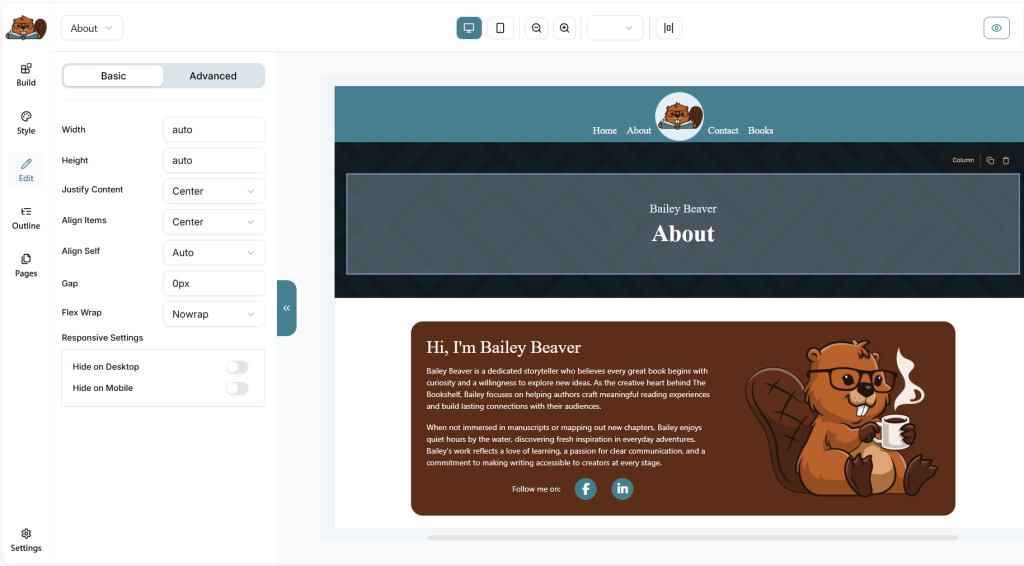
Supporting Growth at Every Stage
Whether you’re launching your first book or managing a deep backlist, The Bookshelf is built to grow alongside your career. Its structure supports evolving needs without requiring a full rebuild as your business expands, and with additional features and updates added at regular intervals, the platform adapts to suit author needs as the industry landscape shifts.
The Bookshelf helps authors scale by supporting:
- Easy ways to showcase and sell growing catalogs of books
- The ability to use multiple types of sales paths and formats of books
- Reader retention and engagement through emailing and intuitive website design
- Continuous learning through an educational branch dedicated to website setup and use, marketing, reader engagement, and author community connection
By combining ownership, simplicity, and scalability, The Bookshelf helps authors build websites that aren’t just functional, but future-ready in every way.
Your author website is more than just a digital placeholder. It’s a long-term foundation for your career, your reader relationships, and your creative independence. By focusing on clarity, ownership, reader-first design, and scalability, you can build a website that will truly help you thrive at every stage of your author journey.
If you’re ready to simplify the process and build an author website designed to grow with you, learn more about how The Bookshelf helps authors take control of their online presence and use it to help their businesses soar.
