
As much as you may not want to believe it, book descriptions are one of the most powerful sales tools you have at your disposal as an author. The best book descriptions hook your reader with the first sentence, introduce your interesting protagonist and the force that opposes them, and focus on the plot, not themes, of your story.
Do you remember a time when you walked through a bookstore, obsessively picking up books with captivating covers and reading the back copy, or flap copy if it was a hardcover, and deciding whether it was the one. The one you were going to buy. (Or perhaps one of the ones, but that’s just semantics.)
feel,Perhaps you weren’t convinced by the book that had nothing but blurbs and reviews, so you put it back on the shelf. Another described a plot that had very different vibes from the cover you were originally entranced by, so you put that back too. The next one doesn’t tell you what the plot is at all, just what you will think and feel when you read it. You don’t like being told what you think and feel so you put that one back too.
But the next one…oh the next one. The first line hooks you. The plot promises your favorite kind of adventure, awaiting your favorite type of character. It calls you back to some of your favorite books of the past few years. This one. This book is coming home with you.
That is the power of a book description, and by the end of this article, you’ll know exactly how to write one so the next time your perfect reader gets a glimpse of your book, they’ll know it’s coming home with them.
The Difference Between Writing and Copywriting
Authors are very familiar with the art of creative writing. Bringing characters and settings and plots to life in a way that feels real to the reader is creative, whether you’re writing fiction or non-fiction (i.e. creative non-fiction). But copywriting is the art of capturing the reader's attention in an “in real life” (IRL) situation and convincing them to buy and read your creative writing.
The two types of writing are very different and also not to be confused with content writing, which is a subject for another day (but this article you’re reading right now is an example of content writing).
Your book description is copywriting. The purpose is to convince a reader to buy your book. Or borrow it from a library. Or accidentally on purpose drop it into your purse before leaving your parents/siblings/friend's place. Your book—your creative writing—must take the reader and transport them into another life. Your book description must make them want to be transported.
Some links in this article are affiliate links.
Some of the book links in this article are affiliate links through Bookshop.org. If you purchase through one of these links, you’ll be supporting independent bookstores and The Bookshelf—at no extra cost to you.
Fiction Book Description vs Non-Fiction
A book description’s entire purpose is to convince a prospective reader to become an actual reader. It’s sales copy and the type of description you write will vary somewhat depending on whether your book is fiction or non-fiction. This article is specifically for fiction, which targets a reader’s desire to explore and inhabit a life, world, or adventure different from their own.
Non-fiction book descriptions, on the other hand, tend to focus on a problem that needs solving, targeting a reader’s desire to either avoid pain or move toward gain in the life, world, or adventure that very much is their own experience.
Before we move on, a quick note on Memoirs and Narrative non-fiction. Some books are non-fiction, but they’re written to be captivating in the same way that fiction is. Think of some of the most successful memoirs of all time:
- The Diary of a Young Girl, by Anne Frank
- Eat, Pray, Love, by Elizabeth Gilbert
- Educated, by Tara Westover
- Becoming, by Michelle Obama
- Born a Crime, by Trevor Noah
What do they all have in common? They are non-fiction stories that read like fiction. So, for the purpose of writing a book description, if you’re writing a memoir or narrative non-fiction, it should follow the rules and recommendations of fiction book descriptions.
AI-Free Fiction Book Description Builder
I know all this data and information can be intimidating and a lot of authors are tempted to jump into an AI tool to write the description for them, but in doing so, you stand to lose a lot of the emotion and voice that makes your book stand out against all the rest. Whatever your personal feelings about AI may be, writing your own book description gives you the unique human touch to pull at heart-strings in just the way readers crave.
We created our Fiction Book Description Builder based on the research behind the patterns and statistics found in top-performing book descriptions—we’ll look at those numbers next! We turned all data into a guided, prompt-based process that helps you write the description in your own words. It does not generate the copy for you. It walks you through the optimal framework, step by step, so you can shape a description that is structured well, emotionally clear, and true to your voice.
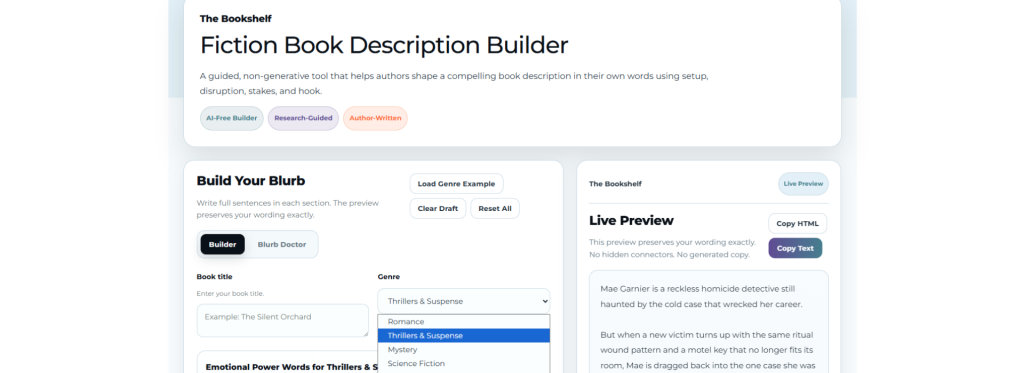
We’ve included fictionalized genre examples (fictionalized in the sense that they’re not real, published books…yet!), and have programmed in the ability to score your description, offering recommendations on what you’re doing well and how you can improve, if you need to.
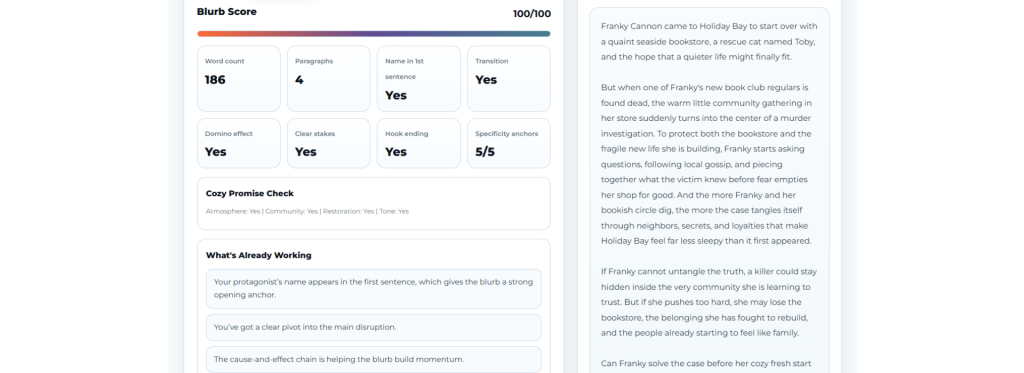
This is a free tool, available to all authors, so you can check it out any time:
The Bookshelf’s Fiction Book Description Builder
The Formula of a Top Selling Book Description
I studied 100+ book descriptions in preparation for this article. They are all top-selling books from the first quarter of 2026 and they are across the most competitive fiction genres: Romance, Thriller/Suspense, Mystery, Science Fiction, Fantasy, Horror, Action Adventure, Historical, Women’s Fiction, and Literary.
They had a lot in common.
- 94% introduced a named character in the first sentence, most commonly using first and last names, but not always.
- 88% establish the protagonist’s setup problem, “real” world complaint, or pressure before the inciting situation appears.
- 91% introduce the main disruption using a transition phrase like “but,” “until,” “when,” or “then.”
- 76% include another named character (often the love interest, antagonist, or ally) within the first half of the description.
- 82% explicitly state the stakes or consequences using phrases like “if,” “the closer,” “now,” or “before it’s too late.”
- 79% end the book description with a decision, dilemma, or unresolved question rather than explaining what happens.
- 67% use a three-paragraph structure (setup -> complication -> stakes).
- 72% fall within the 140–220 word range, which appears to be the sweet spot for fiction book descriptions.
- 85% describe the story’s central conflict, emotional tension, and stakes, instead of a dry play-by-play summary or focusing on the themes
What does this look like in practice? If I were to create a formulaic outline for a great book description based on the 100 top sellers I studied, it would look something like this:
- Introduce your main character—using their name—and their initial problem, conflict, or unease with their current circumstances.
- Mention the disruption, ideally by using a transition phrase like “but” or “then” and include another named character if they are involved with the disruption or inciting incident.
- State and escalate the stakes using emotionally powerful words like “before it’s too late” (or get more specific based on your story)
- Sum everything up with a final line that details your protagonist’s major dramatic question (MDQ) without giving away any spoilers
How Long Should a Book Description Be?
The majority of book descriptions studied used between 140 - 220 words and multiple paragraphs. Based on this, I’d recommend trying to stay below 250 words and including paragraph formatting to make sure it is easy to read at a quick glance.
To get really specific, of the book descriptions researched, the majority averaged:
- Paragraph 1 (Setup): 55-75 words
- Paragraph 2 (Disruption): 45-65 words
- Paragraph 3 (Stakes): 40-60 words
- Final line (MDQ): 12-20 words
You may notice that the paragraphs start slightly longer and get tighter for each section.
Emotional Power Words for Book Descriptions
If you’re researching copywriting, you’ll see a lot of mentions about “emotion” and “power words.” These are crucial for pulling a reader into your book description, but they are often misunderstood or misused.
In a book description, you want to avoid the now-cliché clickbait language or anything that feels hyped up and overly dramatic. Instead, you want to trigger the emotions that lean into the tone, themes, and genre of your book.
If you’re writing a Romance novel, you want to use powerful words that feel romantic or set the tone for the type of romance your characters go through.
- Anticipation
- Danger
- Desire
But those emotions may also be the emotions you want to highly in a Thriller, so the word choice you use is very important. Compare the following:
- Yearning vs Impending
- Forbidden vs Deadly
- Irresistible vs Consuming
Your goal is to convey the powerful pull of your reader’s emotions in genre, tone, or theme-appropriate language.
Use Sharp Specifics
The best book descriptions do not feel vague or interchangeable, even when they follow a familiar structure. What keeps them from sounding generic is specificity.
They include details that belong to this story, create intrigue, and help readers instantly understand why this book is different from the hundreds of others sitting beside it.
In 85% of the descriptions analyzed, at least three different forms of specificity were present. More than half used four or more.
So what counts as a sharp specific?
- The protagonist’s role or status
This often appears in the setup paragraph. It can be a job title, but it usually works best when it points to the character’s position within a larger system: their family, community, workplace, social circle, or power structure. The goal is not just to tell us what they do. The goal is to show us where they stand and what built-in tension comes with that position.
- A clear inciting incident
Skip vague lines like “everything changes” or “her world is turned upside down.” Tell the reader what actually happens. The inciting incident usually shows up within the first few chapters, so it is not a spoiler. It is the moment that kicks the story into motion, and the more clearly you name it, the stronger your description becomes.
- Rules, constraints, or boundaries
Anything that limits your protagonist, raises the difficulty, or shapes the plot can add instant intrigue. You do not need to explain your entire magic system or every detail of your dystopian government. But if your protagonist is trapped on a plane, bound by a deadly bargain, forced into a fake marriage, or forbidden from revealing the truth, that is worth telling us.
- A deadline or ticking clock
Readers love pressure. They love impossible odds made worse by time. If your story includes a looming deadline, a countdown, an approaching event, or consequences that hit at a specific moment, put that in the description. Time pressure sharpens stakes fast.
- A prop, piece of evidence, or MacGuffin
Sometimes what makes a story click is the thing at the center of it: a missing letter, a stolen heirloom, a corpse, a key, a crown, a tape, a child, a ring, a list of names. A MacGuffin is the object, person, or goal that drives the story forward because it matters deeply to the characters. It does not have to be magical or world-altering to matter. It just has to be powerful within the story.
Here are a few rules, with a little tough love:
- If a line could describe five other books in your genre, it is probably too generic.
- Your plot may follow a familiar structure, and that is fine. Most do. But your description should still highlight the pieces that belong to your story and no one else’s.
- Don’t give away spoilers. You can lead up to the climax of your story, but don’t share any plot twists or get anywhere close to revealing the resolution to your story.
Pull from the most interesting moments early in the story, but lean toward the moments that matter most. And if your biggest plot points sound flat on the page, that may be a sign they need a little more finesse before the book is truly ready.
Adding Layers: Romance and Cozy Vibes
When it comes to entertainment, adding romance almost always increases the saleability of a story. That does not mean every book written needs to have romance at the forefront, or even included at all. But it does mean that if you have a romantic subplot or thread to your story, it can give you a great opportunity to capitalize on the attraction of love, sex, and everything in between.
When we think about adding layers to our book descriptions, I am not talking about Romantasy. That has become a genre of its own, where the Romance plot and the Fantasy plot hold equal weight. Without either, the entire story crumbles.
A layer, on the other hand, adds nuance, friction, and emotional stakes that heighten or even contrast the physical (plot) stakes. The story becomes more compelling, intriguing, and gripping, but if you ditched the romance, it would still function as a complete, and ideally even strong, story on its own.
If you have a romance taking place in your story, you can dribble in some teasers to your description like an aphrodisiac. It’s not the main event, but it sets the stage.
“A coroner must expose a cover-up that could link a series of murders before the killer strikes again,” could become…
“A coroner must expose a cover-up that could link a series of murders before the killer strikes again, but the closer she gets to the heart of the deception, the more suspicious her fiancé appears.”
On a separate, though related note, “cozy” has been a modifier that has become so popular, it’s spawned its own genres. Cozy Mystery and Cozy Fantasy are currently the most common, but they’re making such big waves in the publishing space that Sci-Fi and other top sellers aren’t far behind.
In a true mystery or fantasy, the stakes are world-changing and everything feels larger than life. We immerse ourselves in these worlds to feel the extremes without having to live through them ourselves.
When you’re a cozy, it should feel more like a slice of life. You still need stakes, but they’re low. You still need setting, but is inviting and comforting. You still need side characters, but they’re quirky and relatable.
“A scorned sorceress takes vengeance on the wizards who cauterized her magic, threatening to end the natural world as they know it,” would be a bit dramatic for a cozy fantasy.
“A newly single botanist discovers she has a flair for potions when she accidentally turns her cheating ex into the once-extinct Dodo he used to study.”
The layers required for romance don’t necessarily change the story, but a cozy story, without a doubt, follows its own set of rules.
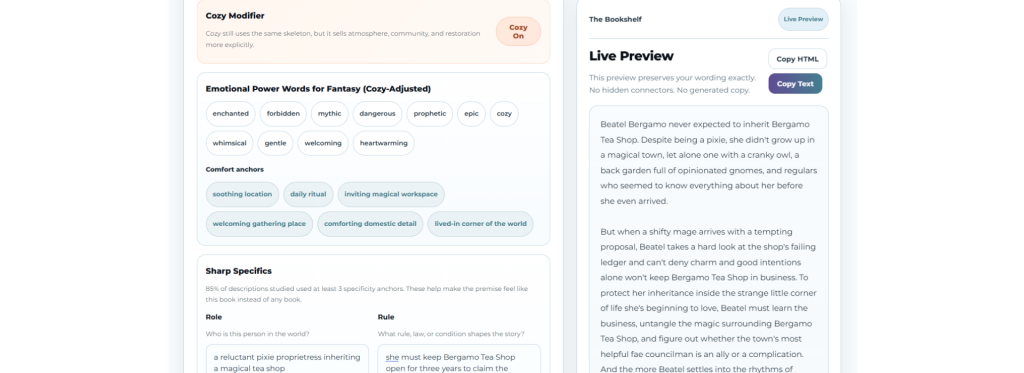
In our Fiction Book Description Builder, there is a toggle to help you add cozy elements to your blurb that will signal to your reader that it’s not just a mystery or a fantasy, it’s a cozy mystery or cozy fantasy.
Bonus Sales Copy: Blurbs and Review Quotes
Most of the top sellers across genres are still traditionally published books. This will often come with perks such as blurbs by other successful authors and/or reviews and quotes that can be added to the sales copy.
Here are a few more statistics from the 100 book descriptions studied:
- 78% included at least one endorsement at the top of their sales copy, before the description began. This acts as social proof and generally came in the form of a bestseller list or book club acknowledgement, award, or a review from an author with a very similar audience
- When an author blurb or review was included, 72% of them paid homage to their reader experience, not the plot.
- 64% did reference the genre though
Self-published authors can create this sales copy too!
Just because traditionally it was organized by the publisher does not mean an author cannot recruit their own accolades.
If you have a critique partner who is also a published author, swap blurbs.
Submit your work to book awards designed for self-published or indie authors. IngramSpark curated A Definitive List of Writing Contests and Book Awards for 2026 to make it easy to find! If/when your book receives standing, add it above your book description in your sales copy.
Self-published authors have to put in the work themselves, but they also get to keep their hard-earned profits.
The 8 Do's and Don'ts of Writing a Great Book Description
In creative writing, every rule is made to be broken, as long as you have a really great reason for breaking it, and you do it with great skill. In copywriting, breaking rules can be a somewhat more precarious adventure.
When it comes down to writing a book description that is going to hook your readers and give them everything they need to know to convince them to buy your book, following the rules will almost always act in your favor.
| DO | DO NOT |
|---|---|
| Start with an irresistible hook—your character in an interesting situation or predicament | Start by dumping backstory or world-building that is either vague or overwhelming |
| Name your protagonist and (ideally) an opposing force, which could be another character, that shows the source of your story's conflict | Name-drop every single character in your book |
| Focus on the plot (what happens) and explicitly mention the stakes | Dwell exclusively on themes (what the takeaway or "feels" are), except for a single summarizing line at the end |
| Use contrast words like "but" or linking words like "forcing" to show how each plot point escalates and is caused by the last/next | Detail all the interesting or exciting moments without explaining why they apply to the story (bigger picture) |
| Use paragraphs and white space for easy readability and aim for a total word count around 250-300 words max | Write a single block of text or ramble on for more than 500 words |
| End with a weighty question, dilemma, or consequence that faces your protagonist | Include spoilers! Don't give away the major twists or resolution! |
| Write in third person, even if your story is in first person. If you choose to write in first person, make sure you have a strong voice and a good reason! | Ego-dump—readers will decide for themselves how brilliant or life-changing your book is; you don't have to tell them |
| Include reader-centric keywords (genre, tropes, character types, etc) | Keyword stuffing—write for humans, not algorithms! |
Related Questions
Should You Include an Author Bio in Your Book Description?
Depending on where you are planning to use your book description, your author bio may be near it, but it is generally not considered part of your book description. For example, if you’re sending out a query letter, the author bio is generally the last paragraph, immediately after the book description. If you’re putting it on your website, you may have an author bio showing after the book description. If it’s on a storefront sales page, there is typically a link or sidebar access to your author bio. Your author bio is incredibly important, but a separate piece of copywriting from your book description.
What is a Major Dramatic Question
The Major Dramatic Question, or MDQ, in a story is the core question that drives the entire narrative. At its most basic, it is “will the protagonist achieve their goal?” Often it includes the alternative as well: “or will they fail.” Of course, each novel will need to customize this simplified line of questioning in a dramatic, exclusive to the story way that piques a reader’s interest.
In A Court of Thorn and Roses by Sarah J. Mass the MDQ isn’t “will she save the world,” but rather, “will Feyre find a way to stop the ancient, wicked shadow from growing, or doom Tamlin and his world-forever?”
In Project Hail Mary by Andy Weir, the MDQ isn’t “will he save the world,” but rather, “will Ryland Grace conquer an extinction-level threat all by himself, or fail, dooming humanity and allowing the earth itself to perish?”
Even in novels that don’t have “save the world” consequences, there is still an MDQ driving the narrative. In To Kill a Mockingbird by Harper Lee, the MDQ isn’t “will justice prevail,” but rather, “will a local [white] lawyer risk everything to defend a black man unjustly accused of a terrible crime, or will hatred and prejudice destroy all hope of justice?”
“Dramatic” is a keyword in the phrase Major Dramatic Question, as is “major.” Make it big, bold, and enticing.
‘Dramatic’ and ‘major’ are both important keywords the phrase Major Dramatic Question. Make sure the stakes are big, bold, and enticing enough to make a reader bring your book home with them.
How to Write a Logline for a Novel
Loglines are very short, very poignant summaries of a story. They’re a staple of the film industry, but successful authors know how to use them to their advantage as well. Imagine a single line that accurately illustrates the main setup and conflict of your story while also artfully inserting descriptions of your protagonist and antagonist. Tall order? Yes. Absolutely. But worth it! A logline tells your audience what they’ll get with your book. There are many formulas you can use, and here are a few you can try, with examples from some of the biggest selling books of 2025:
- X meets Y: “A Gilmore Girls meets
- Creek redemption romcom.” Story of My Life by Lucy Score
- When/After [inciting incident], [protagonist] must [goal or seemingly impossible task]—or else [catastrophic stakes]:“Ryland Grace is the sole survivor on a desperate, last-chance mission—and if he fails, humanity and the earth itself will perish.” Project Hail Mary by Andy Weir
- A [protagonist type or trope] caught between [internal desire] and [external force/opposition]:“[A] young woman caught in the crosscurrents between her heart’s deepest desires and the cruel, careless games the Olympian gods play.” I, Medusa by Ayana Gray
- [Protagonist] refuses to let anything interfere with [goal]… except [dilemma]:“Nothing interferes with pro hockey star Shane Hollander's game. Now that he's captain of the Montreal Voyageurs, he won't let anything jeopardize that–definitely not the sexy rival he loves to hate.” Heated Rivalry by Rachel Reid
- [Protagonist(s)]+ [quest] + [setting] + [antagonist(s)]:“Join Coast Guard vet Carl and his ex-girlfriend’s cat, Princess Donut, as they try to survive the end of the world—or just get to the next level—in a video game–like, trap-filled fantasy dungeon.” Dungeon Crawler Carl by Matt Dinneman
