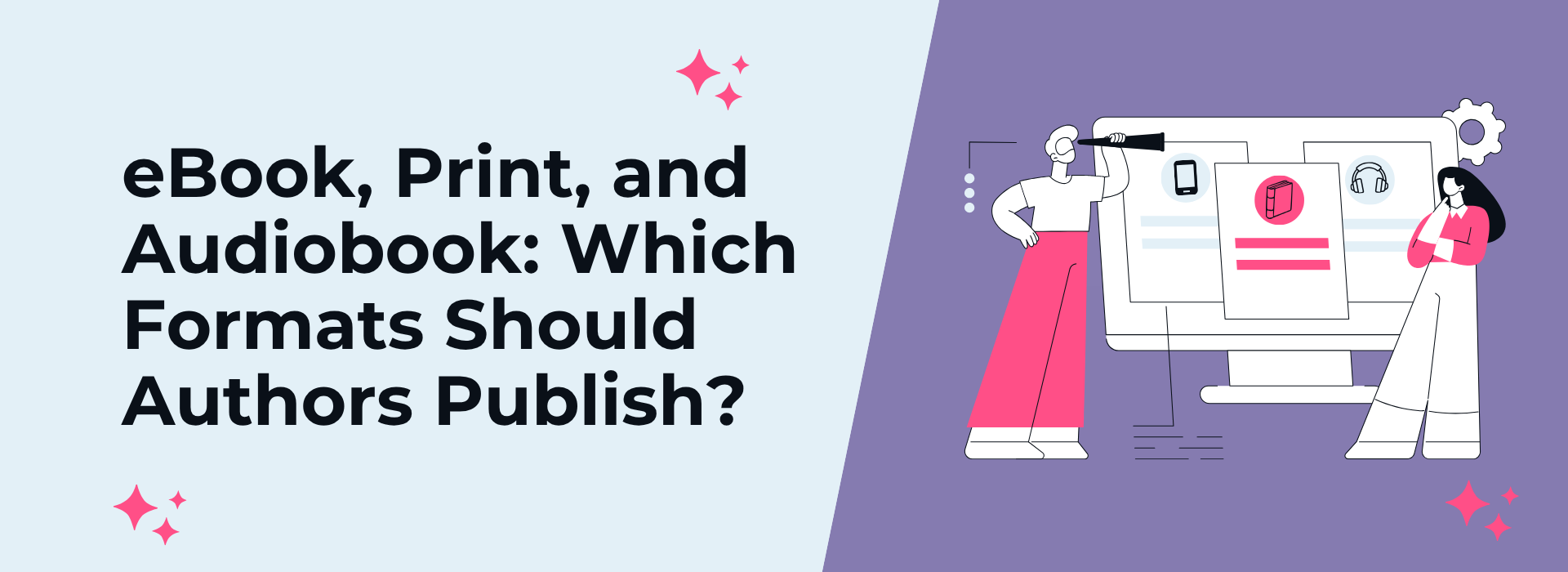
When you’re deciding how to publish a book, the formats you choose to produce aren’t just a technical choice. They’re strategic, too.
Each format (eBook, print, and audiobook) reaches readers in different ways, carries different costs, and plays a different role in your long-term growth as an author. That may seem overwhelming, but the great news is that you don’t have to do everything at once. Many indie authors build their format lineup in stages, starting out simple and expanding as their audience grows.
Let’s break down how each format works and some of the strategies for navigating when to produce them for your books.
What Are the Main Book Formats?
While there are many ways to publish and consume stories these days, when it comes to publishing a book, there are three main formats that most authors consider: eBooks, print books (which include paperback and hardcover), and audiobooks.
eBooks
eBooks are the digital version of your book that readers can download instantly to devices like Kindles, Kobos, or phones and tablets. Only on these specialized devices or apps can these “reflowable files” be displayed to read as intended.
The central characteristics of eBooks are that they’re:
- Delivered instantly
- Typically priced lower
- Highly portable
- Easy to update (e.g. fixing typos, updating backmatter, etc.)
eBooks really dominate indie publishing because they carry the least amount of friction for both authors and readers. They’re especially powerful for genre fiction like romance and fantasy, where readers binge series.
Print Books
A print book is any type of physical copy of your book, whether that’s a paperback or a hardcover version.
While avid readers may opt for eBooks, according to a 2025 survey and subsequent 2026 report by the Pew Research Center, “print continues to be the only format used by a majority of Americans. Roughly two-thirds of adults say they have read a physical book in the past 12 months.”
What does this mean for authors? It means that there are still many readers out there who prefer physical copies of their books, so it’s a format that shouldn’t be overlooked.
The key characteristics of print books are that they’re:
- Tangible and collectible
- More expensive to produce
- Require specialized formatting
- Offer a variety of sub-formats to produce (paperback, laminate hardcover, dust jacket hardcover)
Some form of print is excellent to have not just for readers who prefer physical books, but for overall credibility as a published author. It also provides expanded opportunities for things like selling signed copies or selling at live events.
Audiobooks
Audiobooks are digital, narrated versions of your books that are distributed through audiobook platforms to then be listened to on those platforms (such as Audible, Spotify, or iTunes), most often via a phone or tablet.
The key characteristics of audiobooks are that they:
- Require narration (DIY, hired narrator, or AI narration)
- Have a higher upfront cost
- Serve a rapidly growing market
- Are often consumed passively (e.g. while driving or exercising)
Audiobooks are a massively growing slice of the reader market. They offer a chance to tap into a different kind of reader: one that isn’t interested in or may not have time to read an eBook or print book, but still wants to consume what books have to offer.
Where Should Beginner Authors Start?
If you’re just getting started with your first book or two, trying to launch in every single format from the very beginning is a fast way to burn out and overspend.
Though not every strategy is resolutely applicable to every author and their situation, a great one to consider as an effective starting point is to make the eBook first priority and the paperback second priority.
eBooks should come first because they:
- Have the lowest cost to produce
- Are the fastest to publish
- Are easiest for testing your market
- Are ideal for building a readership
For many indie authors, eBook sales drive the majority of their early revenue.
Once your eBook is ready, adding a paperback version is a natural next move because it:
- Expands your reach to print readers
- Adds legitimacy to your book
- Enables more opportunities like selling signed copies
The jump from eBook to paperback is relatively small compared to other formats, even though they do each require their own unique file formats and processes to create those. But the eBook/paperback combo tends to be the most common for new authors’ first books.
When to Add More Formats
Scaling your formats should be an intentional action, not an automatic one. If your goal is to treat your writing like a true author business, each new format should serve a purpose to support that business. And most often, that purpose should be demand for the product.
The next step many authors take after eBook and paperback is producing a hardcover. The best time to add them is when:
- You have an established audience
- Readers are asking for more specialized editions
- You want higher-margin direct sales
Hardcovers provide excellent perceived value to readers, making them great for superfans of your work. They also allow for more specialized products, such as those with foiling or sprayed edges (though these can be applied to most paperback books as well).
Next, you can consider expanding into audiobooks. This format is rapidly becoming very powerful, but it does also require the biggest leap in terms of cost and production. The best time to invest in audiobooks is usually when:
- Your eBook and print versions are selling consistently
- You have a proven series or strong read-through
- You can reasonably expect a return on your investment (or have the means to treat it as a long-term investment)
Audiobooks are great for tapping into a brand new pool of readers, helping you to increase your overall revenue streams, and deepening your engagement with your audience.
Special Editions and Box Sets
Though not technically their own types of format, special editions and box sets are additional products you can add to your offerings when the demand for them supports doing so. And they can be very fun, brand-driven items to add.
Examples of special editions include:
- Illustrated editions
- Signed copies
- Limited-run copies
- Bespoke editions (foiling, sprayed edged, dust jacket, ribbons, etc.)
Whereas a box set can include a variety of offerings:
- Bundling an entire series of print books
- Bundling the first book of multiple series
- Including swag in the box (stickers, pins, mugs, T-shirts, etc.)
- Specialized packaging (customized boxes or packing paper)
The best time to explore adding special editions or box sets to your offerings is when you are selling direct through your own store, as most marketplace retailers don’t offer these kinds of items. It also helps to have a loyal fanbase already creating demand for these products, as they can be expensive to produce, but can become a major revenue driver for established authors.
Deciding Which Formats are Right for You
There is no one-size-fits-all answer to deciding how and when to create the various formats of your book. But there are some helpful guiding questions to answer when thinking it through:
- How do your genre’s readers prefer to consume books?
- What is your current budget?
- Are you focused on rapid growth or long-term brand building?
- Do you plan to sell direct from your website?
If you’re early in your journey, simplicity will almost always win. That means nailing your eBook and paperback first, building momentum from there, and expanding to other formats when the revenue and demand support doing so.
But the bottom line is that you don’t need every format immediately (or ever) to be a successful author. You just need the right formats at the right time. As your readership grows and your income stabilizes, you can layer in the additional formats that support your goals. Think of book formats as a ladder: you don’t climb it all at once—you take it just one smart step at a time.
Related Questions
Which book format makes the most money?
This most heavily depends on your audience and pricing strategy, but eBooks tend to generate the most volume for indie authors. That said, print editions can offer higher profit margins per sale when done strategically, such as by selling direct or creating bespoke editions with higher price points.
How much does it cost to publish a book?
The key to understand here is that self-publishing a book isn’t an all-inclusive fee wrapped up in a neat bow at the beginning of the process. There are several steps (including editing, formatting, cover design, website creation, marketing, and more) that all require different costs depending on what level you want to produce your book at. To learn more about the costs associated with self-publishing a book, check out this article.
How should I price each format of my book?
A good rule of thumb to follow here is that the more the format costs to produce, the higher you should price it. Different genres will also often have different pricing expectations, as will how the book is sold (direct vs. retailer). To learn more about pricing your books, check out this article.
